What is Impedance?
Impedance (Z) is the total opposition in an AC circuit that blocks the flow of current (I). Both Resistance (R) and Reactance (X) are included in it.
Impedance is the vector sum of Resistance and Reactance, representing the total opposition in an AC circuit.
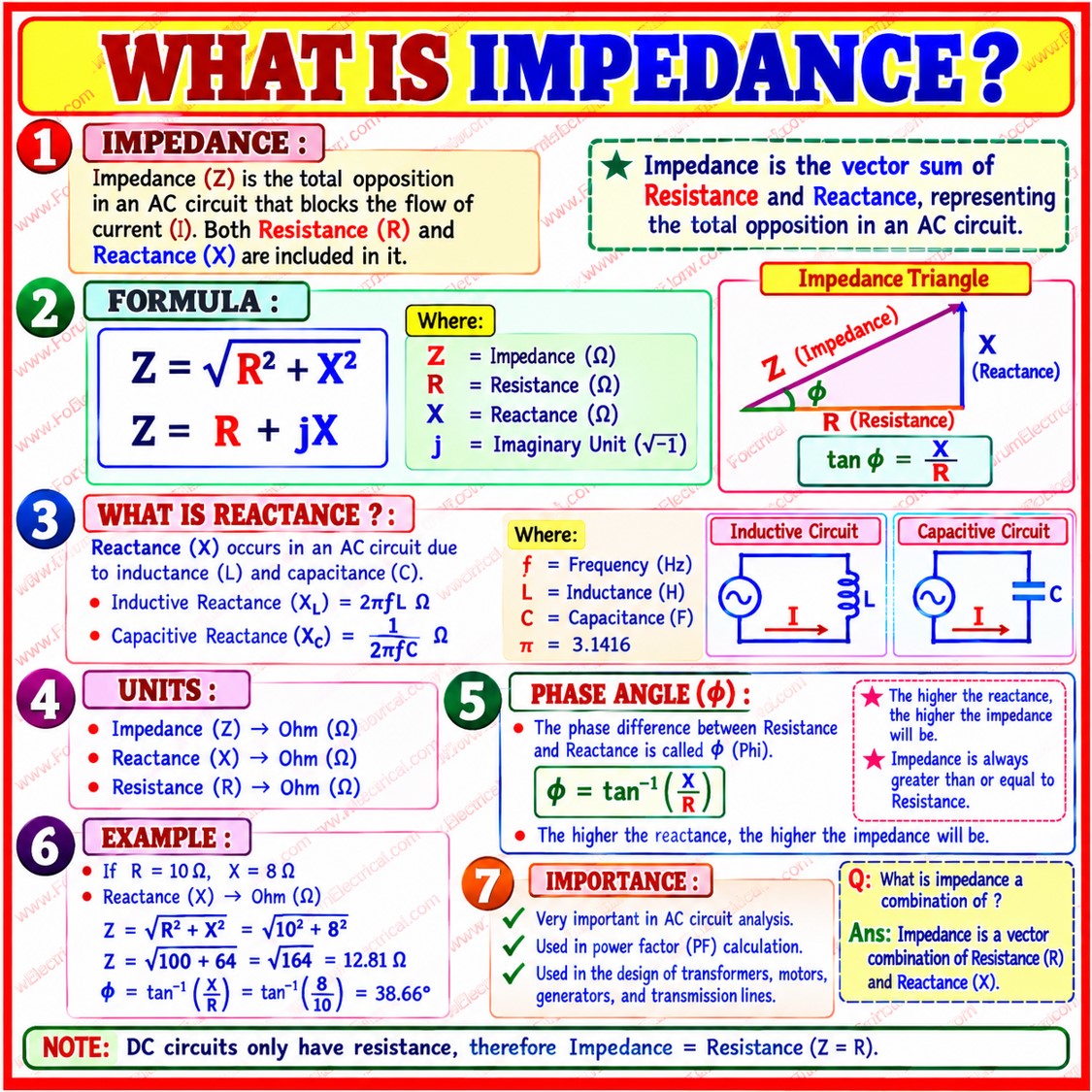
Formula
Z = √(R² + X²)
Z = R + jX
Where:
Z = Impedance (Ω)
R = Resistance (Ω)
X = Reactance (Ω)
j = Imaginary Unit (√−1)
Impedance Triangle: Z = Impedance, X = Reactance, R = Resistance
tan φ = X / R
What is Reactance?
Reactance (X) occurs in an AC circuit due to inductance (L) or capacitance (C).
Inductive Reactance: XL = 2πfL Ω
Capacitive Reactance: XC = 1 / (2πfC) Ω
Where:
f = Frequency (Hz)
L = Inductance (H)
C = Capacitance (F)
π = 3.1416
Units
Impedance (Z) → Ohm (Ω)
Reactance (X) → Ohm (Ω)
Resistance (R) → Ohm (Ω)
Phase Angle (φ)
The phase difference between Resistance and Reactance is called φ (Phi).
φ = tan⁻¹(X / R)
The higher the reactance, the higher the impedance will be.
Impedance is always greater than or equal to Resistance.
Example
If: R = 10 Ω, X = 8 Ω
Reactance (X) = 8 Ω
Z = √(R² + X²)
Z = √(10² + 8²)
Z = √(100 + 64)
Z = √164 = 12.81 Ω
φ = tan⁻¹(X / R)
φ = tan⁻¹(8 / 10) = 38.66°
Importance
Impedance is:
Very important in AC circuit analysis.
Used in power factor (PF) calculation.
Used in the design of transformers, motors, generators, and transmission lines.
Note
DC circuits only have resistance; therefore:
Impedance = Resistance (Z = R)