A Power Factor Meter is an electrical instrument utilized to measure the power factor of an electrical system.
Power factor indicates how efficiently electrical power is being converted into useful work. It is defined as the ratio of real power (kW) to apparent power (kVA), and is expressed as:
Power Factor (cosφ) = kW / kVA
A power factor close to 1 (unity) means maximum efficiency, while a lower value indicates energy losses in the system.
Measuring power factor is very important in electrical systems.
A good power factor improves energy efficiency, reduces electricity bills, prevents overheating of equipment, and enhances overall system performance. Poor power factor leads to higher current flow, increased losses, voltage drops, and penalties from electricity boards.
There are different types of power factor meters available.
- Analogue meters provide direct reading using pointer-based scales.
- Digital meters are more accurate and display precise values. Clamp-on meters allow measurement without disconnecting the circuit, making them convenient for maintenance work.
Power factor can be measured using different methods.
The direct connection method is used for balanced loads. The indirect method uses current transformers (CTs) for high current circuits.
The clamp-on method is a non-contact method used for quick and safe measurements.
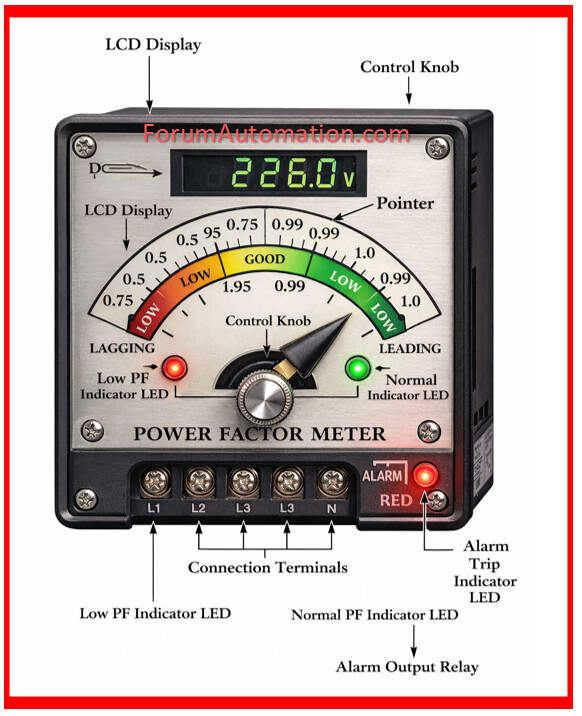
Power factor is classified into 3 types.
Unity power factor (PF = 1) is ideal where all supplied power is converted into useful work.
- Lagging power factor (PF < 1) occurs in inductive loads such as motors and transformers.
- Leading power factor occurs in capacitive loads such as capacitor banks and can approach unity.
The measurement procedure involves ensuring proper safety using PPE, connecting the meter correctly, selecting power factor mode, and observing the reading. For CT-based measurement, the CT is clamped around the conductor. The meter then displays the power factor value, usually between 0 and 1, without any unit.
A good power factor value is close to unity. Ideally, PF = 1 is the best condition. A value between 0.95 to 1.0 is considered good, while 0.90 to 0.95 is acceptable. If the power factor is below 0.90, it indicates poor performance and requires correction.
Common problems related to low power factor include excessive reactive power, harmonics, and load imbalance.
These issues can be solved by installing capacitor banks, using harmonic filters, and maintaining proper load distribution. Overcompensation should be avoided, as it can lead to leading power factor problems.