Difference between NTC and PTC Thermistors
Thermistors are temperature-dependent resistors that are commonly employed in electrical and electronic systems for detecting, controlling and protecting.
Thermistors are categorized into two categories based on their resistance changes with temperature:
- NTC (Negative Temperature Coefficient) Thermistor and
- PTC (Positive Temperature Coefficient) Thermistor
NTC (Negative Temperature Coefficient) Thermistor
An NTC thermistor is a device whose resistance lowers as temperature increases.
This pattern happens because higher temperatures increase the quantity of charge carriers in semiconductor material lowering resistance.
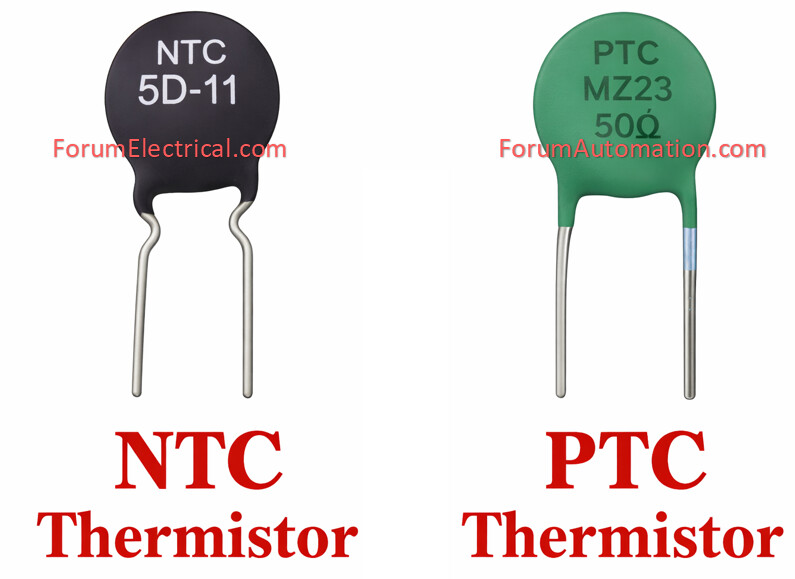
NTC thermistors are highly sensitive and accurate temperature measurement devices making them ideal for sensing, monitoring & inrush current limiting applications.
PTC (Positive Temperature Coefficient) Thermistor
A PTC thermistor is a device whose resistance increases as temperature rises particularly after reaching a predetermined threshold temperature.
This rapid increase in resistance limits current flow allowing the thermistor to function as a self-protecting mechanism.
PTC thermistors are mostly employed for thermal and overcurrent safety rather than exact temperature measurements.
Difference between NTC and PTC Thermistors
NTC vs PTC Thermistors
| Parameters | NTC Thermistor | PTC Thermistor |
|---|---|---|
| Temperature coefficient | Resistance in an NTC thermistor decreases as temperature increases. | Resistance in a PTC thermistor increases with temperature. |
| Sensitivity | An NTC thermistor is extremely sensitive to minor temperature changes. | A PTC thermistor is less sensitive and reacts mostly around a critical temperature. |
| Resistance - Temperature behaviour | An NTC thermistor exhibits a smooth & continuous nonlinear resistance change. | A PTC thermistor’s resistance increases sharply after reaching a threshold temperature. |
| Accuracy | An NTC thermistor enables precise temperature measurement. | A PTC thermistor is inappropriate for accurate temperature measurements. |
| Primary function | An NTC thermistor is primarily used to measure temperature and control inrush current. | PTC thermistors are primarily utilized for thermal & overcurrent protection. |
| Protection capability | An NTC thermistor does not offer direct protection from overheating. | A PTC thermistor automatically reduces current when it overheats. |
| Typical applications | NTC thermistors are widely utilized in SMPS, battery packs, HVAC systems & sensors. | A PTC thermistor is widely used in motor windings, transformers & resettable fuse circuits. |
You can also follow us on AutomationForum.co, Facebook and Linkedin to receive daily Instrumentation updates.
You can also follow us on ForumElectrical.com , Facebook and Linkedin to receive daily Electrical updates.