Difference between Capacitor and Reactor
Capacitors and reactors are both passive electrical components used in power systems, but they perform opposite functions.
A capacitor stores electrical energy in an electric field and supplies reactive power to improve voltage and power factor.
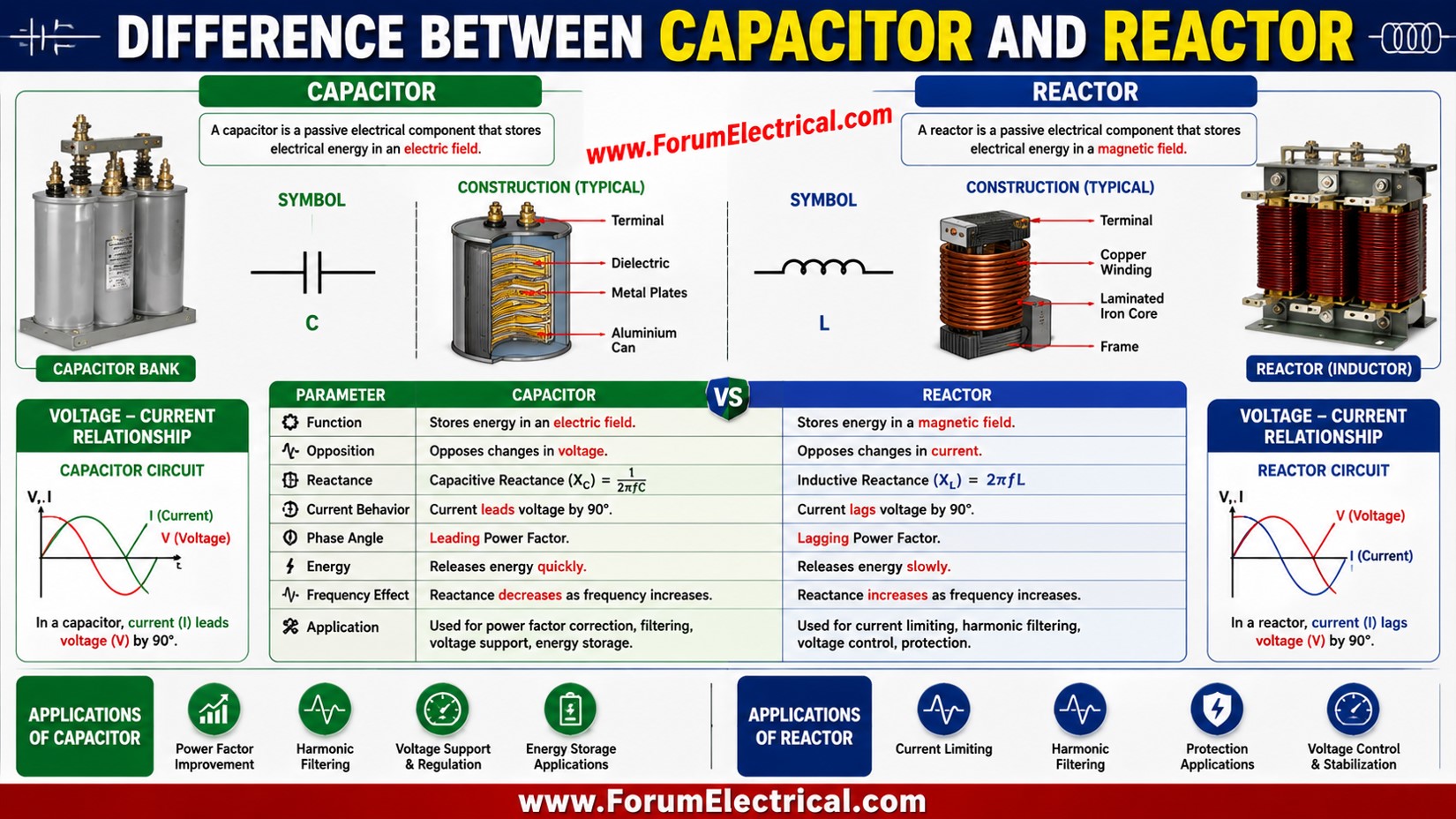
A reactor (inductor) stores energy in a magnetic field and absorbs reactive power to limit current, control voltage, and reduce harmonics.
Capacitor vs Reactor Comparison
| Parameter | Capacitor | Reactor (Inductor) |
|---|---|---|
| Definition | Stores energy in an electric field | Stores energy in a magnetic field |
| Main Function | Supplies reactive power | Absorbs reactive power |
| Electrical Quantity | Capacitance (Farad, F) | Inductance (Henry, H) |
| Symbol | Two parallel plates | Coil of wire |
| Reactance Formula | Xc = 1 / (2πfC) | XL = 2πfL |
| Frequency Effect | Reactance decreases as frequency increases | Reactance increases as frequency increases |
| Current-Voltage Relationship | Current leads voltage by 90° | Current lags voltage by 90° |
| Power Factor Effect | Improves lagging power factor | Reduces leading power factor |
| Energy Storage | Electric field | Magnetic field |
| Power Consumption | Supplies capacitive VAR | Consumes inductive VAR |
| Voltage Effect | Increases system voltage | Reduces or controls system voltage |
| Current Effect | Can increase charging current | Limits fault and inrush current |
| Losses | Very low dielectric losses | Copper and core losses |
| Applications | Power factor correction, voltage support, filtering | Current limiting, harmonic filtering, fault current limitation, voltage control |
| Common Installation | Capacitor banks, motors, substations | Series reactors, shunt reactors, harmonic filter reactors |
| Maintenance | Inspection for swelling, leakage, and dielectric condition | Inspection for overheating, insulation, winding integrity, and vibration |