Why Wrong I/O List Created Major Commissioning Delay?
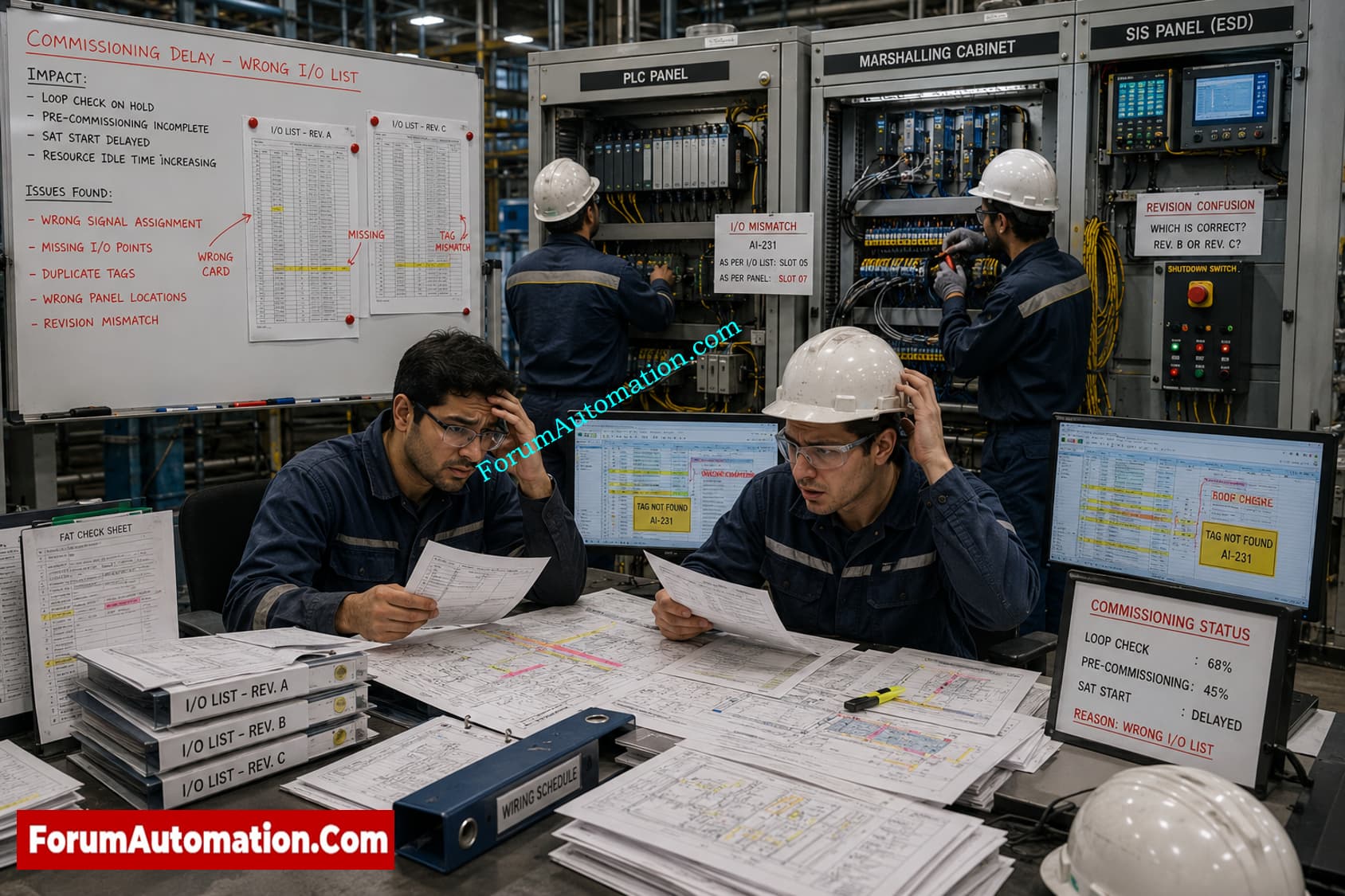
An EPC contractor was executing a large refinery automation project involving more than 2500 instrumentation signals connected to a new DCS and Safety Instrumented System. During the commissioning phase, engineers discovered that several analog input channels configured in the PLC and DCS did not match the actual field wiring. Some pressure transmitters were configured as digital inputs, while multiple shutdown switches belonging to the Safety Instrumented System were mistakenly assigned to the normal process control system.
Operators also noticed that several control valves were responding incorrectly during loop checks. A few fail close valves were configured as fail open in the control logic. In addition, many HART enabled transmitters were listed only as standard analog signals without communication requirements. The marshalling cabinet wiring became confusing because the signals were not grouped properly by process unit, voltage level, or hazardous area classification.
The project team later found that multiple revisions of the I/O list were circulating between instrumentation, electrical, and automation departments. Some engineers were working with outdated spreadsheets while others modified newer revisions without proper document control. Because of these inconsistencies, procurement ordered incorrect I/O cards and several control panels required rewiring during FAT and SAT activities.