1 Like
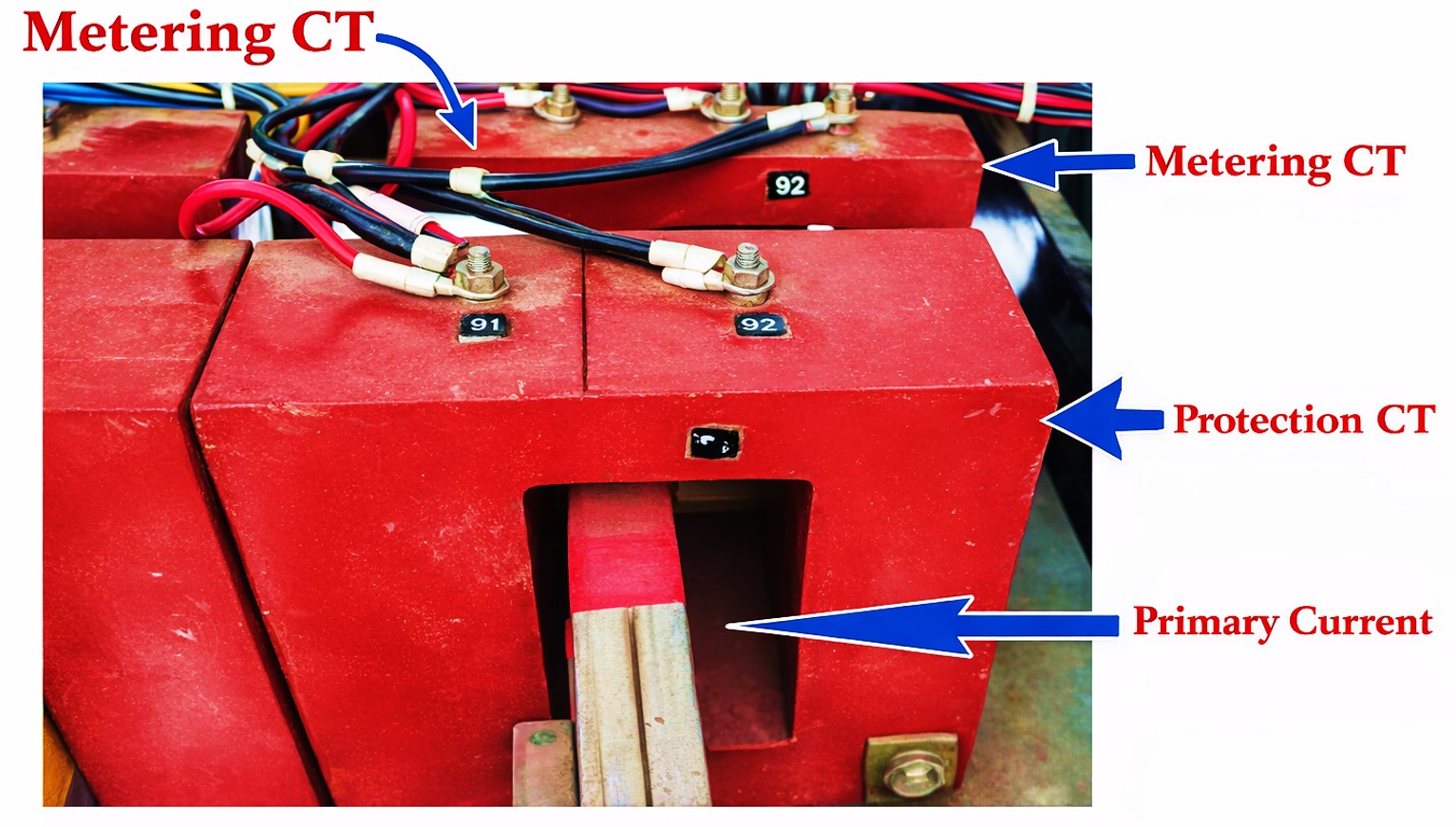
Even if 2 current transformers (CTs) possess the same primary-to-secondary ratio (for example: 400/5 A), they can act extremely differently since protection CTs and metering CTs are designed for completely different applications.
The primary differences are in their basic properties, performance requirements, saturation functioning and operating conditions.
Difference in Intended Function
Metering CTs are intended to give good accuracy at typical operating currents which range between 5% & 120% of rated current.
Their major function is to provide exact measurements for energy meters, ammeters & power monitoring equipment.
Protection CTs, on the other end are intended to function reliably under fault conditions where currents can reach 10-20 times the rated value ensuring that protective relays operate correctly.
Core Design & Saturation Characteristics
The most important difference is fundamental saturation condition.
Metering CTs are specifically intended to saturate quickly during high fault currents.
This protects meters from damage while rendering them unsuitable for protection.
Protection CTs employ high-permeability, high-knee-point cores that maintain linear even at extremely high currents allowing relays to detect the true fault size.
As a result of a short circuit:
1). A metering CT rapidly saturates distorting the secondary current.
2). A protective CT remains unsaturated providing accurate current to the relay.
Accuracy Category & Burden Capability
Metering CTs are classified into accuracy classes such as 0.2, 0.5, or 1.0, which indicate exactly they replicate current under normal load and rated burden (VA).
Protection CTs are defined by classes such as 5P10, 10P20 and PX which imply:
1). Maximum permissible composite error.
2). Accuracy up to a specified multiple of the rated current.
3). Ability to drive heavier loads (relay coils + wire)
Thus regardless of the same ratio a protective CT can withstand significantly larger VA loads without losing accuracy.
Knee-point Voltage & Relay Performance
Protection CTs have a substantially higher knee-point voltage, allowing them to send enough secondary current to relays through faults without overheating.
Metering CTs feature a low knee-point voltage which is suitable for instrumentation but insufficient for relay operation.
This is why relays attached to metering CTs may underperform, malfunction, or fail to trigger.
Safety & System Reliability Considerations
Utilizing a metering CT for protection could compromise system safety since fault currents may not be properly recognized.
On the other end employing protective CTs for metering is viable but frequently avoided because they are less accurate at low currents & more expensive.
You can also follow us on AutomationForum.co, Facebook and Linkedin to receive daily Instrumentation updates.
You can also follow us on ForumElectrical.com , Facebook and Linkedin to receive daily Electrical updates.