Why Ratio Control System Caused Reactor Temperature Fluctuation?
A chemical plant used a ratio control system to maintain the correct proportion between reactant A and catalyst flow entering a reactor. The process normally operated with a fixed 5:1 ratio to maintain stable reaction temperature and product quality. During a production increase, operators noticed sudden reactor temperature fluctuations, off specification product quality, and continuous oscillation in the catalyst control valve.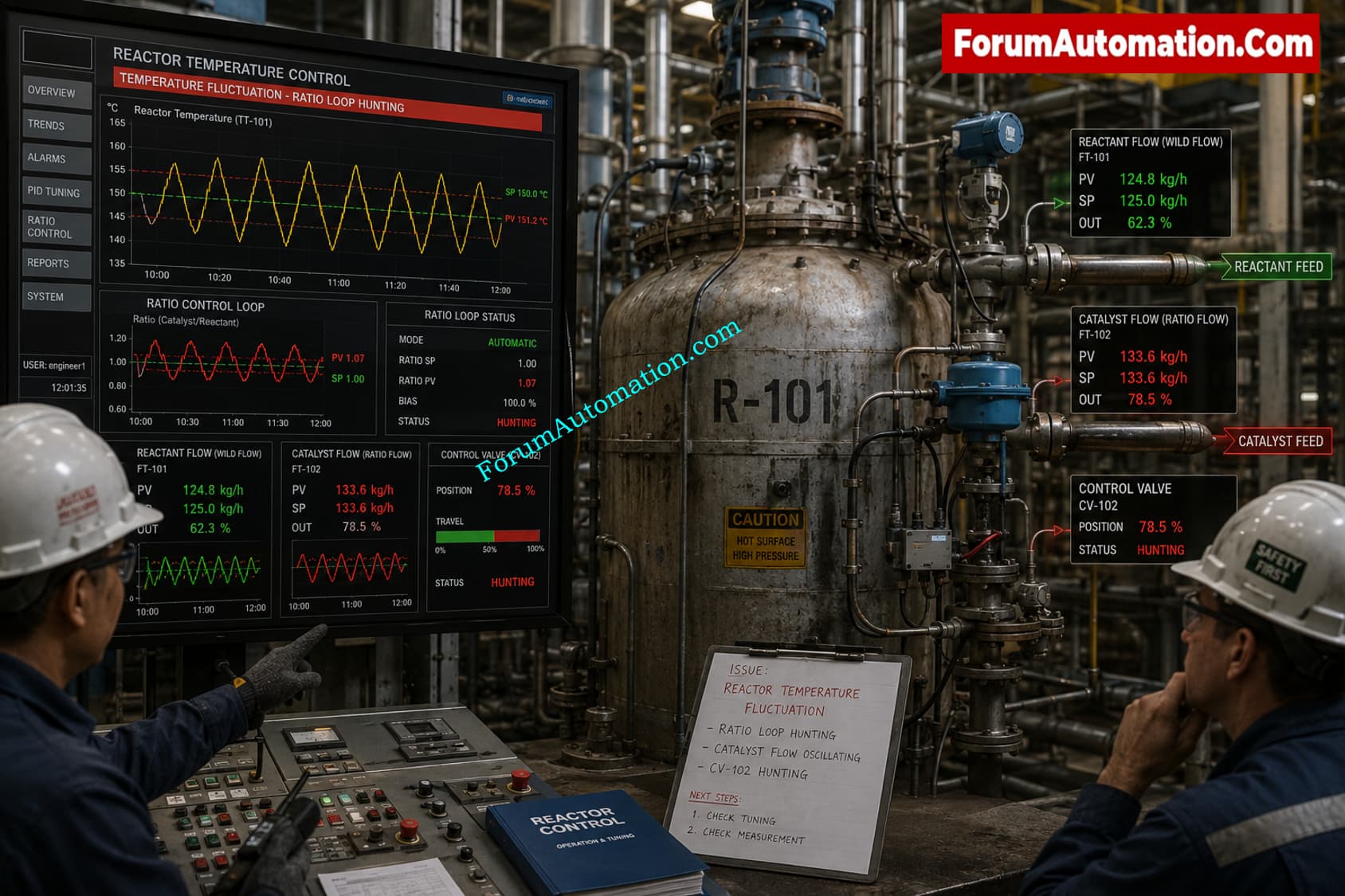
The main reactant flow was considered the wild flow and frequently changed according to production demand. The catalyst flow control loop automatically adjusted itself to maintain the required ratio. However, after the throughput increased rapidly, the catalyst valve started hunting continuously and the reactor temperature became unstable.
Field technicians checked the control valve, flow transmitter calibration, and reactor temperature sensor, but all instruments were functioning normally. Trending analysis later showed that the catalyst flow controller was responding too aggressively to rapid changes in the wild flow signal. The PID tuning of the secondary ratio loop had high proportional gain and integral action, causing overshoot whenever the primary flow changed suddenly.
Engineers modified the PID tuning, added signal filtering to the wild flow measurement, and limited the rate of change for the catalyst flow setpoint. After implementing these corrections, the ratio stabilized and the reactor temperature returned to normal operating conditions.