The 30° phase displacement in a star–delta (Y–Δ) transformer occurs due to the inherent phasor relationship between line and phase voltages in star and delta connections that is combined with the physical winding arrangement of the transformer.
1). Phase and Line voltage relationship in Star Connection
In a star (Y) connection:
Each phase winding is connected between a line and the neutral point.
The line voltage (VL) is the vector difference of two phase voltages.
Mathematically:
VL = 3 x Vph
More importantly the line voltage leads the phase voltage by 30°.
Phasor relation:
VRY leads VRN by 30°
2). Phase and Line voltage relationship in Delta Connection
In a delta (Δ) connection:
Each phase winding is directly connected between two lines.
Therefore:
VL = Vph
There is no phase shift between line voltage and phase voltage in delta connection.
3). Combined Effect in Star–Delta Transformer
When the primary is connected in star and the secondary in delta:
Primary line voltage leads its phase voltage by 30°
Secondary line voltage is equal to its phase voltage (no shift)
Because the transformer transfers voltage from primary phase winding to secondary phase winding & this difference in line-phase relationships results in a net 30° phase shift between primary and secondary line voltages.
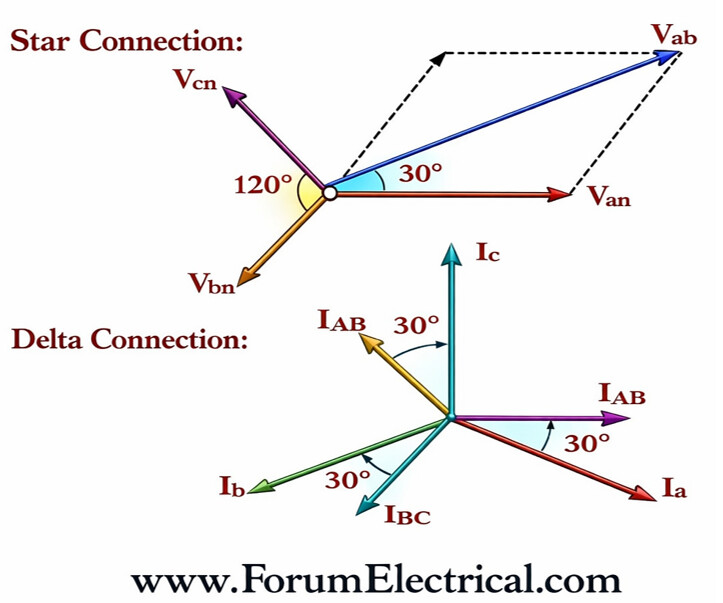
4). Phasor Explanation
Step-by-step:
Primary phase voltage induces secondary phase voltage (same phase relationship based on polarity).
Primary line voltage is shifted by +30° relative to its phase voltage.
Secondary line voltage is not shifted relative to its phase voltage.
Therefore, the primary and secondary line voltages differ by 30°
5). Vector Group Representation
This phase shift is expressed using vector group notation:
Examples:
Yd1 → 30° lag
Yd11 → 30° lead
Clock notation:
Each hour = 30°
Example: Yd11 → 11 x 30° = 330° = −30° (or 30° lead)
6). Physical Interpretation
The phase shift occurs due to:
Different geometrical connection of windings
Difference between line and phase voltage phasors
Electromagnetic coupling transfers phase voltage, not line voltage
7). Summary Table
| Connection | Line vs Phase Voltage Relationship | Phase Shift |
|---|---|---|
| Star (Y) | Line voltage leads phase voltage | 30° |
| Delta (Δ) | Line voltage equals phase voltage | 0° |
| Star–Delta transformer | Difference between primary and secondary line voltages | 30° |
The 30° phase shift in star–delta transformers occurs because the star connection introduces a 30° difference between line and phase voltages, while delta does not.
Since transformers transfer phase voltages between windings, this results in a 30° displacement between primary and secondary line voltages.