Why Is Line Voltage Higher in a Star Connection?
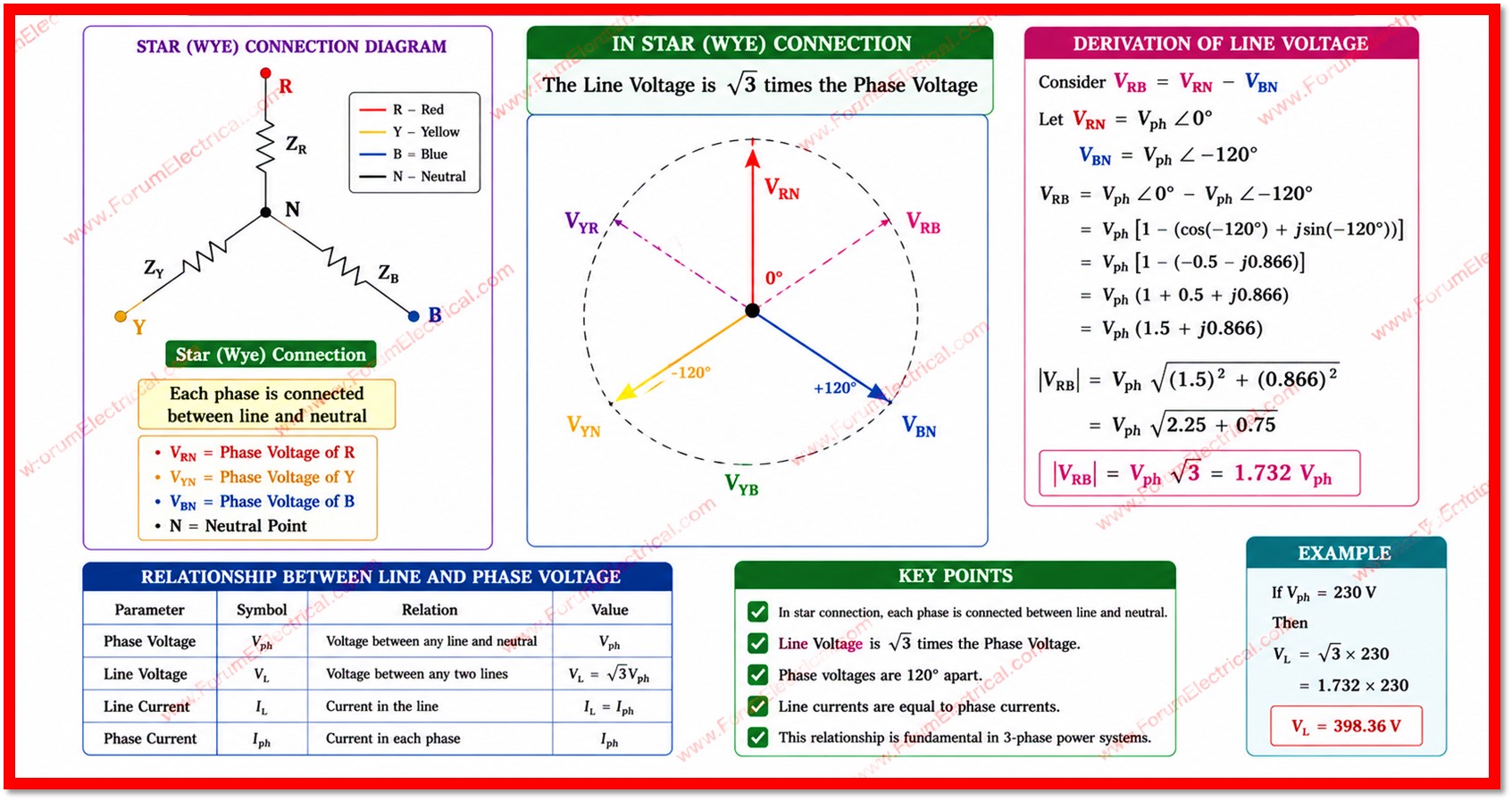
Reference Image Provided by the Respondent
In a star (Y) connection, one end of each of the three windings is connected to a common neutral point, while the other ends are connected to the three phase lines. This configuration is widely used in power generation, transmission, and distribution systems because it provides both phase and line voltages.
In a three-phase star connection, the line voltage is the vector difference between two phase voltages that are 120° apart. Due to vector addition, the line voltage becomes √3 (1.732) times greater than the phase voltage.
Line Voltage (VL) = √3 x Phase Voltage (VPh)
For example, if the phase voltage is 230 V, the line voltage is: VL = √3 x 230 = 398 V ≈ 400 V
Star connections are commonly used in transformers, alternators, distribution networks, industrial power systems, and commercial electrical installations where both three-phase and single-phase supplies are required.