In many industrial facilities repeated motor failures are often blamed on manufacturing defects.
However practical experience shows that most electric motor burnouts occur due to installation mistakes, incorrect operating conditions (or) improper protection settings rather than faults in the motor itself.
Below are 3 of the most common reasons why industrial electric motors fail prematurely:
1). Incorrect (or) Unstable Voltage Supply
Electric motors are designed to operate within a specific voltage range. For example, a motor rated at 415 V must receive a stable supply close to this value.
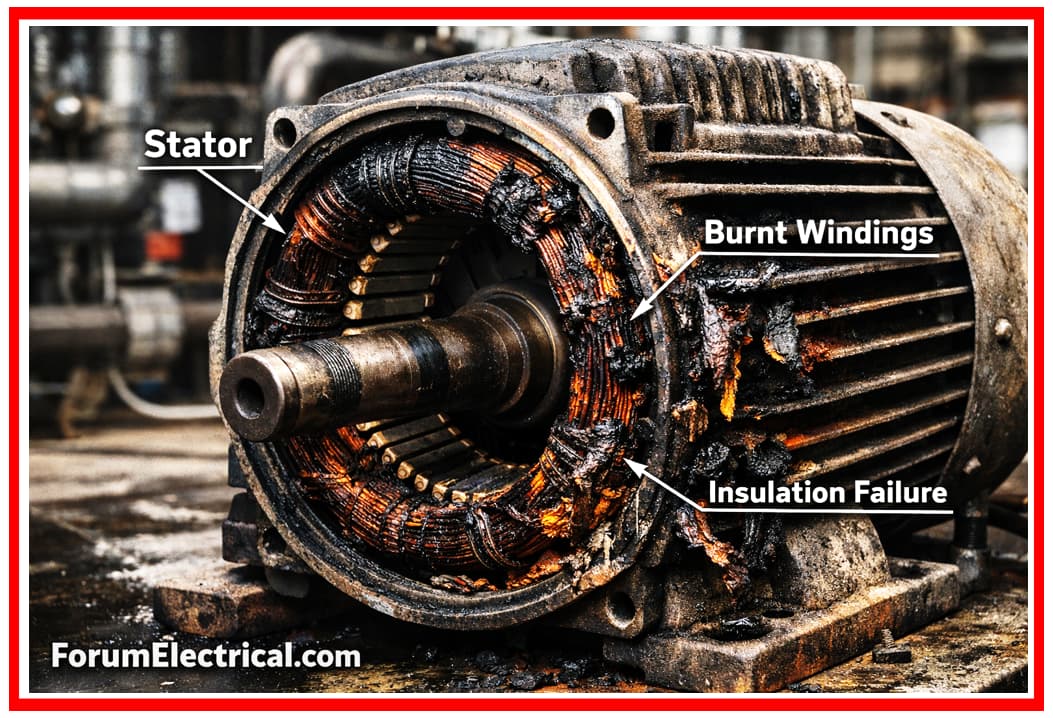
When the supply voltage is low, unstable, or unbalanced, the motor attempts to maintain its torque by drawing higher current. This increased current results in excessive heating within the stator windings.
Result:
Increased current leads to Excess heat generation
Excess heat leads to Insulation deterioration
Insulation failure leads to Motor winding burnout
Maintaining proper voltage levels and minimizing voltage fluctuations are therefore critical for motor longevity.
2). Improper Overload Protection Settings
Overload relays are essential for protecting motors against overcurrent conditions.
However, in many installations technicians install the relay but fail to configure it correctly.
The overload relay setting should generally be adjusted to approximately 100% to 110% of the motor’s Full Load Current (FLA) as specified on the motor nameplate.
If the setting is too high:
The motor will operate under excessive current for long periods.
Thermal stress increases inside the windings.
If the setting is too low:
The motor may trip unnecessarily causing operational interruptions.
Proper relay calibration is therefore essential for effective motor protection.
3). Incorrect Star–Delta Connection
Many industrial motors are designed for star delta starting to reduce starting current. However, incorrect wiring during installation can significantly damage the motor.
For example:
If a motor nameplate specifies 415 V in Delta it must run in Delta during normal operation.
Incorrect star or delta connections can cause abnormal voltage distribution across the windings.
This leads to:
Overstressing of the motor windings
Increased heating
Eventual insulation failure and motor burnout
Always verify the nameplate voltage configuration before making electrical connections.
A simple but important rule in motor installation and maintenance is:
Always read and follow the motor nameplate specifications before installation.
Correct installation practices and proper protection settings can significantly extend the lifespan and reliability of industrial electric motors.
You can also follow us on AutomationForum.co, Facebook and Linkedin to receive daily Instrumentation updates.
You can also follow us on ForumElectrical.com , Facebook and Linkedin to receive daily Electrical updates.