Why does a Healthy 3-Phase System Have Positive Sequence?
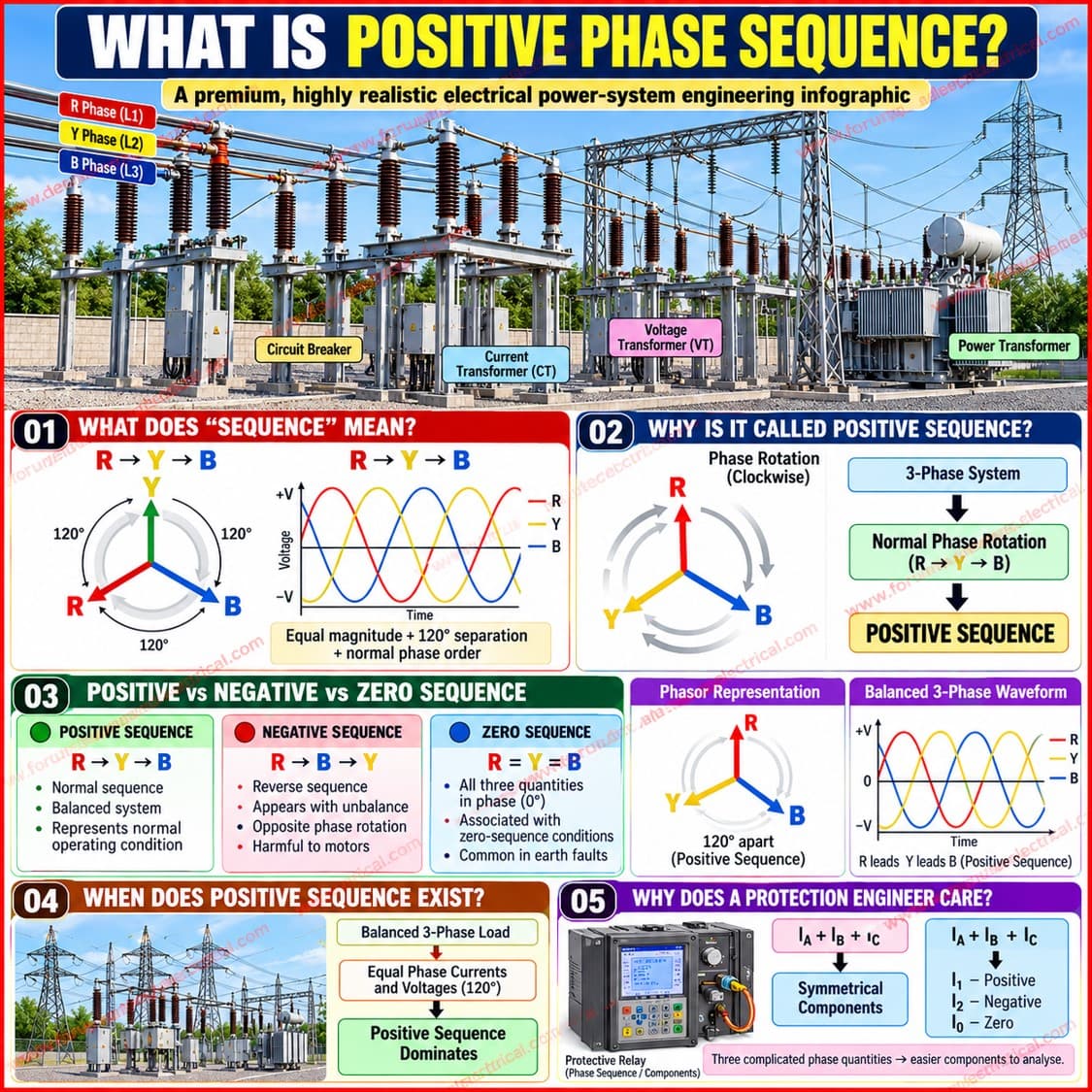
In a balanced three-phase power system, the three phase currents have equal magnitudes, a 120° phase displacement, and the correct phase rotation. This is known as the positive-sequence component.
Why is positive sequence important?
Positive sequence represents the normal balanced operating condition of a three-phase power system. When an unbalanced condition or fault occurs, negative- and zero-sequence components may also appear.
Positive Sequence: Represents the normal phase rotation and balanced component.
Negative Sequence: Represents a reverse phase rotation and can cause overheating in rotating machines.
Zero Sequence: Represents three phasors that are equal in magnitude and in phase, subject to the system’s grounding and fault-current paths.
Protection engineers use symmetrical components to analyse three-phase currents and voltages more effectively, especially during earth faults, phase-to-phase faults, and other unbalanced conditions.
By separating the electrical quantities into positive-, negative-, and zero-sequence components, engineers can better understand fault conditions and improve power system protection.