Why does a Circuit Breaker sometimes fail to clear a fault at the first current zero?
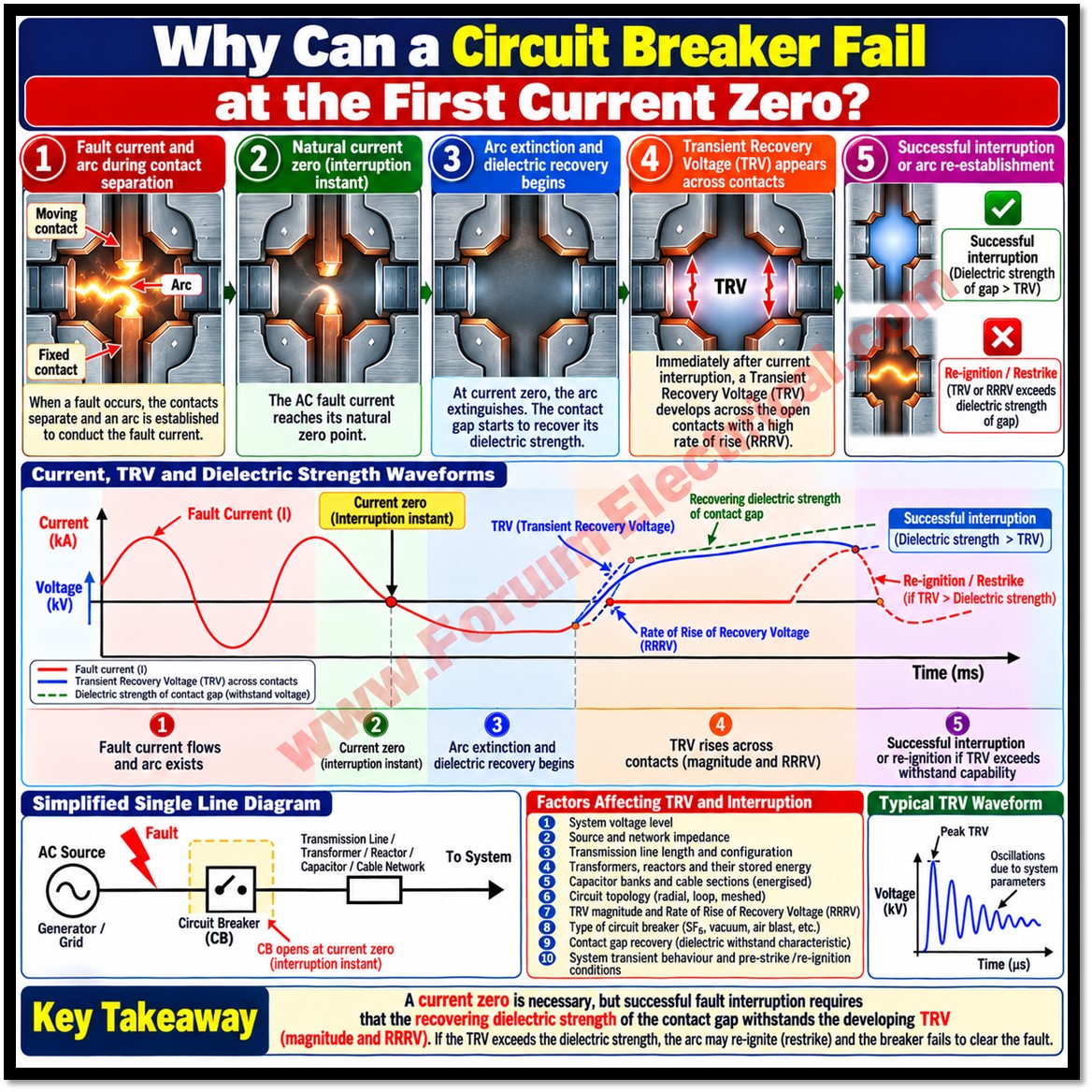
A circuit breaker cannot be considered to have successfully cleared a fault merely because the fault current reaches its natural zero point.
In an AC network, the current crosses zero periodically. At this instant, the arc between the breaker contacts may extinguish—but successful interruption depends on what happens immediately afterward.
Following current interruption, a Transient Recovery Voltage (TRV) develops across the separating contacts.
For reliable interruption, the insulating strength between the contacts must increase rapidly enough to withstand the rising recovery voltage.
If the TRV rises faster than the dielectric strength of the contact gap can recover, the arc may form again. This can result in restrike or re-ignition, depending on the switching condition.
The interruption sequence can therefore be understood as:
Fault current reaches zero → Arc extinction → Dielectric recovery → Contact gap withstands TRV
The characteristics of the electrical network also have a major influence on this process.
Transmission lines, transformers, reactors, capacitors, cable sections and overall system configuration can significantly affect the magnitude and rate of rise of the recovery voltage.
A current zero is only the beginning of successful fault interruption—the breaker must also withstand the rapidly developing voltage across its contacts.