Why do Relays have both NO and NC Contacts?
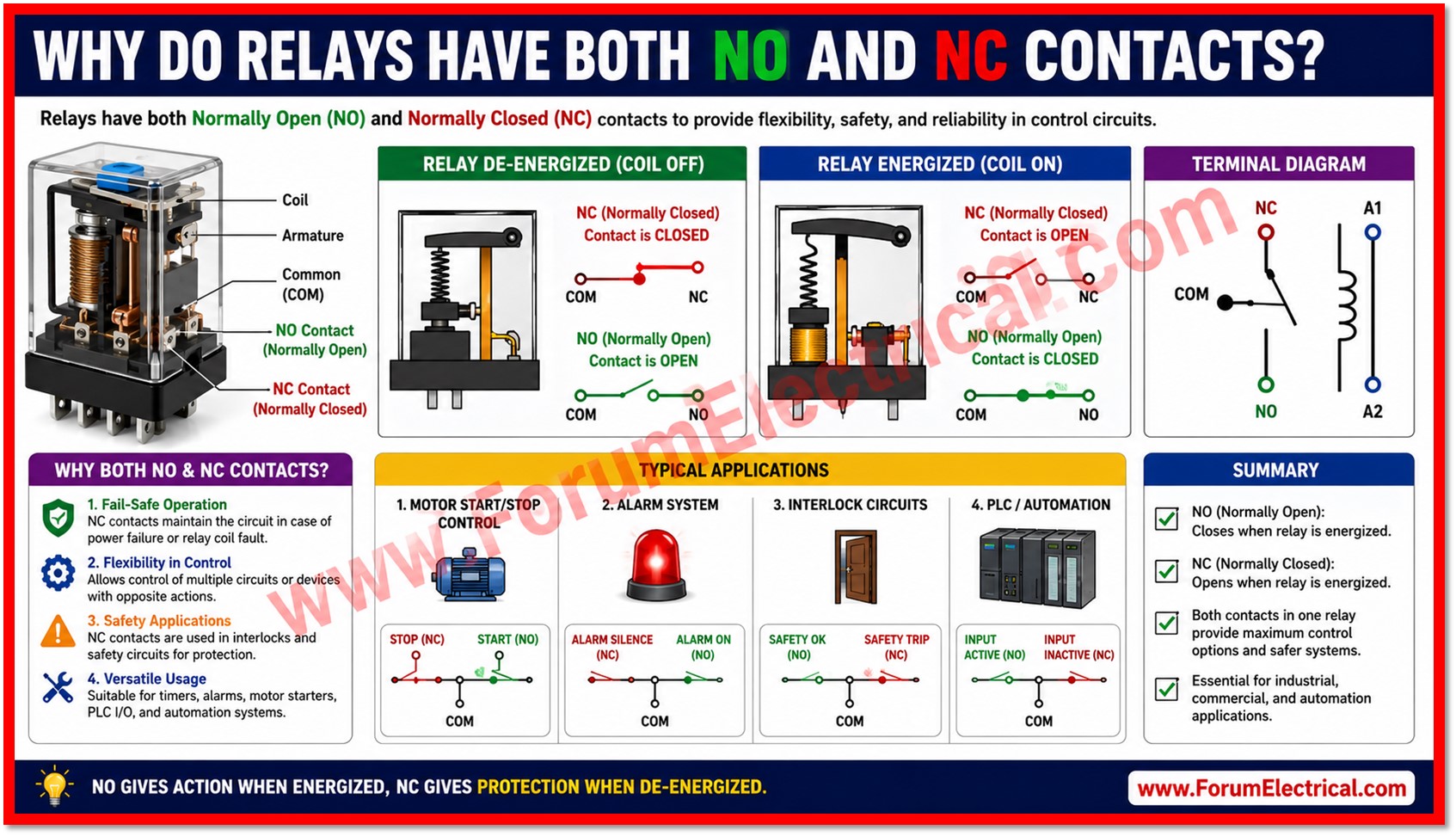
Relays are designed with both Normally Open (NO) and Normally Closed (NC) contacts to provide flexible control and protection in electrical circuits. These contacts allow a relay to perform different switching functions using a single control signal.
Normally Open (NO) Contact
An NO contact remains open when the relay coil is de-energized and closes when the relay is energized. It is commonly used to switch loads ON only when the relay receives a control signal.
Normally Closed (NC) Contact
An NC contact remains closed when the relay coil is de-energized and opens when the relay is energized. It is widely used in safety circuits, alarms, and interlocking systems where a circuit must remain active until a specific condition occurs.
Why Both Contacts are Needed?
Having both NO and NC contacts enables a relay to control multiple circuits simultaneously, implement fail-safe operations, perform changeover switching, and support automation, motor control, and protection applications with greater flexibility.
The combination of NO and NC contacts makes relays highly versatile, allowing engineers to design reliable, safe, and efficient electrical control systems for a wide range of industrial and commercial applications.