START and STOP push buttons are the most common control devices used in industrial motor control circuits. They allow operators to safely start and stop electrical equipment such as motors, pumps, conveyors, and industrial machines.
START Push Button
The START push button uses a Normally Open (NO) contact. When pressed, the contact closes, allowing current to flow through the control circuit and energizing the contactor or relay to start the motor.
STOP Push Button
The STOP push button uses a Normally Closed (NC) contact. Under normal conditions, the contact remains closed, allowing current to pass. When pressed, the contact opens, interrupting the control circuit and stopping the motor immediately.
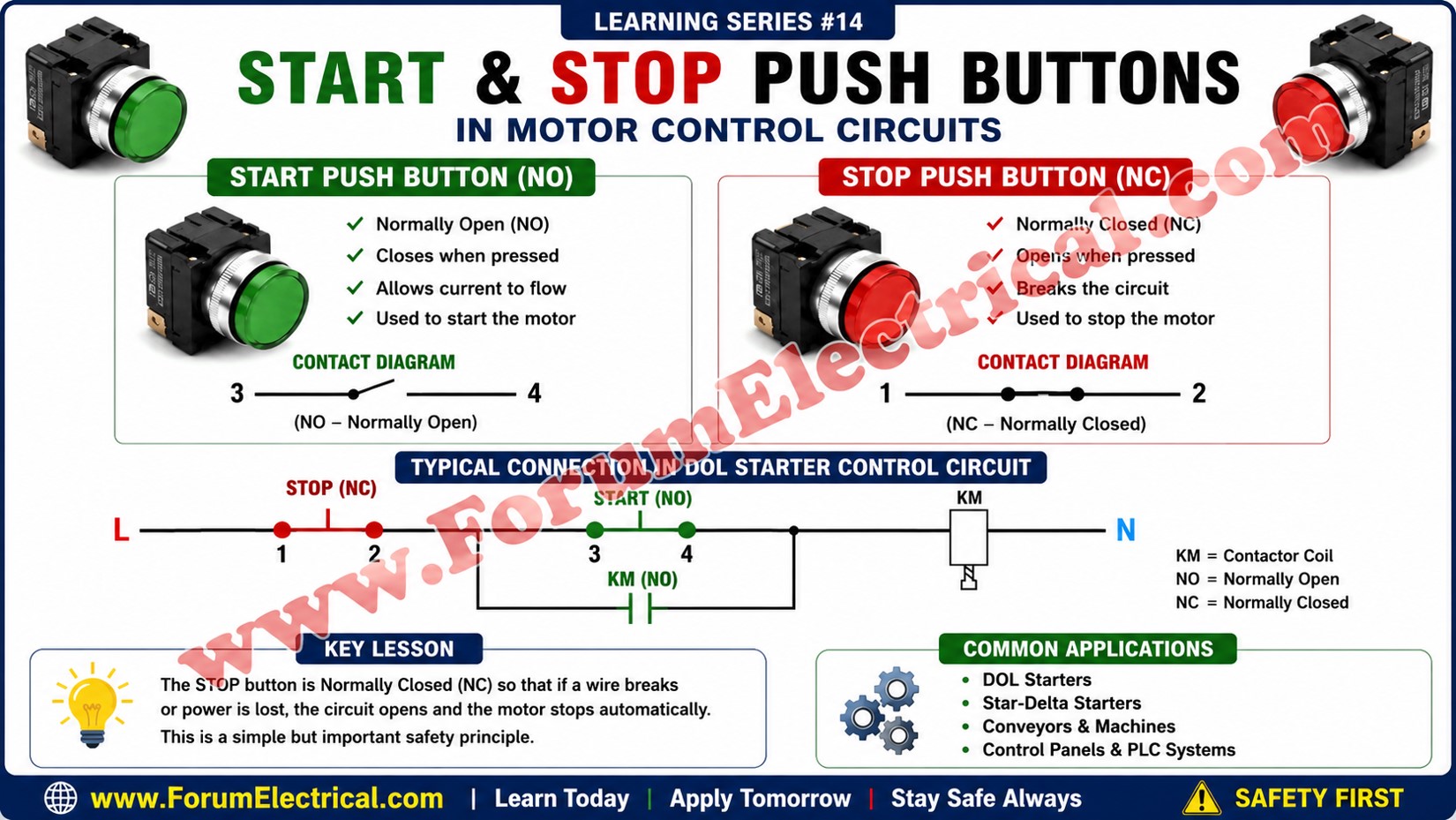
Comparison Table
| Feature | START Push Button | STOP Push Button |
|---|---|---|
| Contact Type | Normally Open (NO) | Normally Closed (NC) |
| Normal State | Open | Closed |
| Action When Pressed | Closes the circuit | Opens the circuit |
| Function | Starts the motor | Stops the motor |
| Current Flow (Normal Condition) | No current | Current flows |
| Safety Purpose | Initiates operation | Provides safe shutdown |
Common Applications
- Direct-On-Line (DOL) starters
- Star-Delta starters
- Conveyor systems
- Industrial machinery
- PLC control panels
- Motor Control Centers (MCCs)
The STOP push button is intentionally designed as Normally Closed (NC) to provide fail-safe operation. If a control wire breaks, a connection becomes loose, or power is lost, the control circuit opens automatically, causing the machine to stop and improving operator safety.