Why are Copper Busbars preferred Over Cables in Electrical Panels?
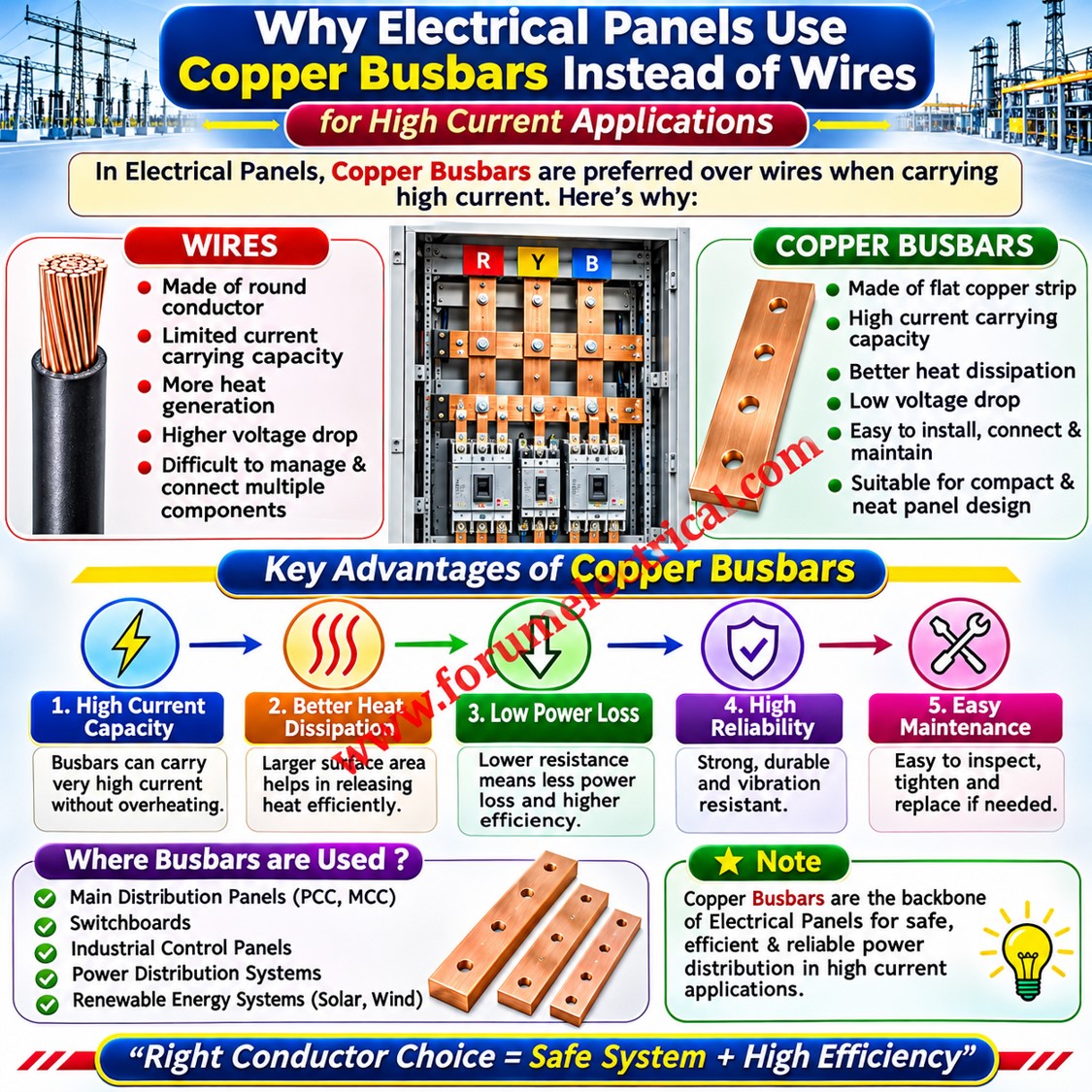
Copper busbars are widely used in high-current electrical distribution systems because of their excellent electrical conductivity, mechanical strength and thermal performance.
Key technical advantages include:
- High Current-Carrying Capacity: Supports high-current distribution with appropriate cross-sectional area and installation conditions.
- Efficient Heat Dissipation: Provides effective thermal performance when properly designed and ventilated.
- Low Electrical Resistance: Helps minimize resistive power losses and voltage drop.
- Compact Panel Configuration: Enables space-efficient conductor arrangements and organized power distribution.
- Mechanical Strength: Provides rigid conductor support and stable electrical connections.
- Maintenance Accessibility: Facilitates inspection, connection tightening, and modification of panel distribution systems.
Copper busbars are commonly used in Power Control Centres (PCC), Motor Control Centres (MCC), LV switchboards, industrial control panels, and electrical power distribution assemblies.
Proper busbar sizing must consider rated current, temperature rise, short-circuit withstand capacity, ambient temperature, installation arrangement, and applicable electrical standards.