Why are conductor positions exchanged after a pole?
In overhead transmission and distribution lines, conductor positions are sometimes exchanged from one pole or tower to another.
This arrangement is called transposition.
What is Conductor Transposition?
Conductor transposition means changing the physical position of the three phase conductors along the transmission line so that each phase occupies each physical position for approximately one-third of the line length.
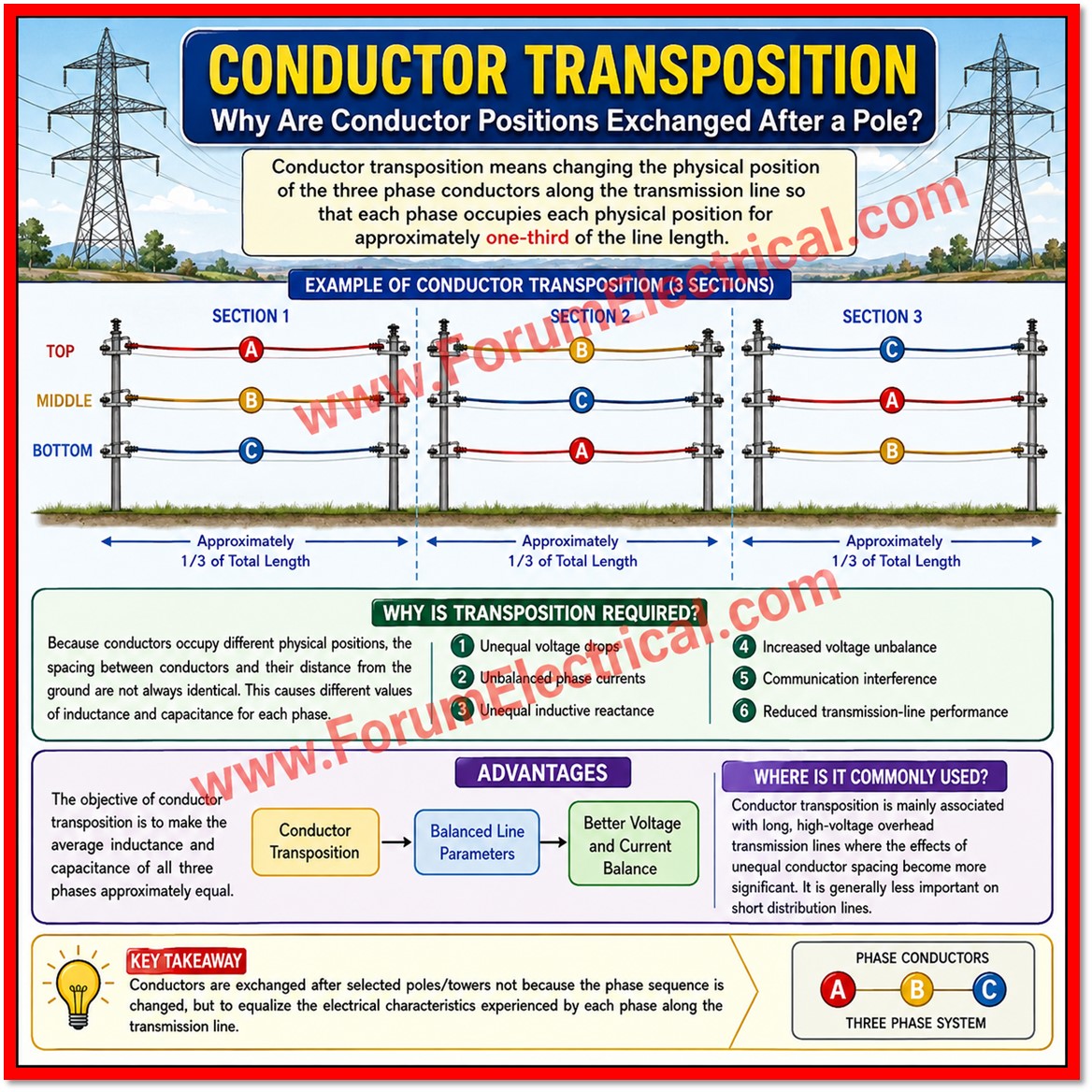
For example:
Section 1:
A → Top | B → Middle | C → Bottom
Section 2:
B → Top | C → Middle | A → Bottom
Section 3:
C → Top | A → Middle | B → Bottom
Why is Transposition Required?
The main reason is to balance the electrical characteristics of the three phases.
Because conductors occupy different physical positions, the spacing between conductors and their distance from the ground are not always identical. This causes different values of inductance and capacitance for each phase.
If the conductors remain in the same positions throughout a long line, the phases can have unequal impedance, resulting in:
- Unequal voltage drops
- Unbalanced phase currents
- Unequal inductive reactance
- Increased voltage unbalance
- Communication interference
- Reduced transmission-line performance
By exchanging the conductor positions, each phase experiences approximately the same physical environment over the complete line length.
Advantages
The objective of conductor transposition is to make the average inductance and capacitance of all three phases approximately equal.
Therefore:
Conductor Transposition → Balanced Line Parameters → Better Voltage and Current Balance
Where is it commonly used?
Conductor transposition is mainly associated with long, high-voltage overhead transmission lines where the effects of unequal conductor spacing become more significant. It is generally less important on short distribution lines.
Conductors are exchanged after selected poles/towers not because the phase sequence is changed, but to equalize the electrical characteristics experienced by each phase along the transmission line.