Why analog input 4/20mA?
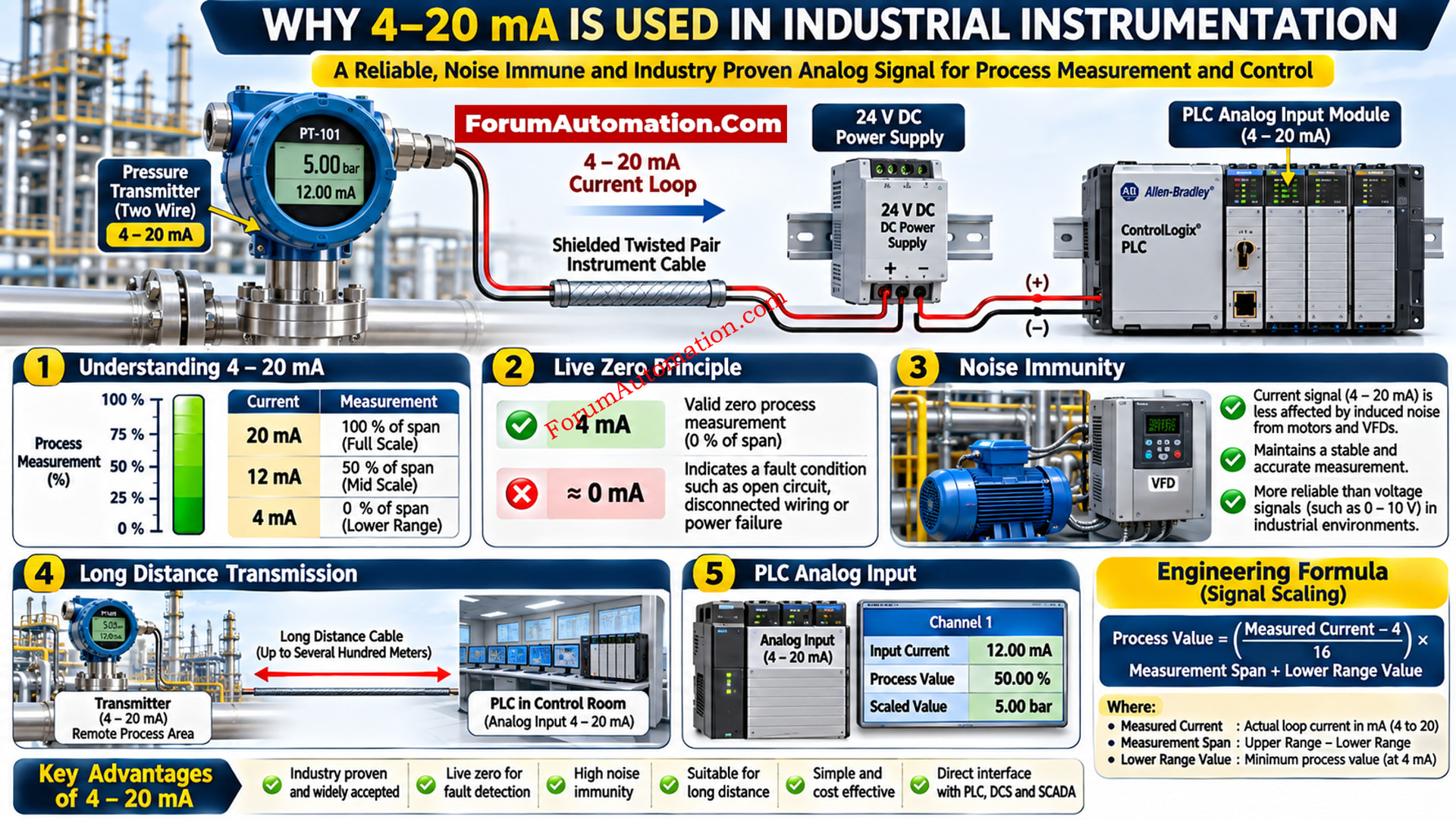
Why Is 4-20 mA Used for Analog Inputs?
The 4–20 mA signal provides reliable long distance transmission, noise immunity, and fault detection. It is common for pressure, flow, level, and temperature transmitters connected to PLC and DCS analog input cards.
1. Live Zero for Fault Detection
A 4 mA live zero represents zero percent of the calibrated range, while 20 mA represents 100 percent.
If the PLC receives approximately 0 mA, engineers can investigate an open circuit, disconnected cable, failed transmitter, or lost loop power. Fault thresholds depend on transmitter configuration and applicable standards.
2. Better Noise Immunity
Plants contain motors, drives, and transformers that introduce interference.
A current loop is generally less sensitive to induced voltage noise than voltage signaling, making it suitable for electrically noisy environments.
3. Long Distance Transmission
Cable resistance causes voltage drop in long wiring runs. A designed current loop maintains regulated current within the transmitter’s compliance voltage, supporting reliable remote measurements.
4. Loop Powered Instruments
Two wire transmitters receive operating power through the same pair carrying the 4–20 mA signal. This reduces cable requirements and simplifies installation.
Practical Engineering Example
For a pressure transmitter ranged from 0 to 10 bar, 4 mA represents 0 bar, 12 mA represents 5 bar, and 20 mA represents 10 bar.
What Should Engineers Check?
Verify loop supply voltage, polarity, input card configuration, grounding, shielding, cable resistance, and calibration.
Engineering takeaway: 4-20 mA remains a dependable standard for process measurement and troubleshooting.