Why 25 kV is used for Railway Electrification?
Power Generation
Electricity required for railway electrification is initially generated at power plants at a voltage level of around 11 kV to 22 kV AC.
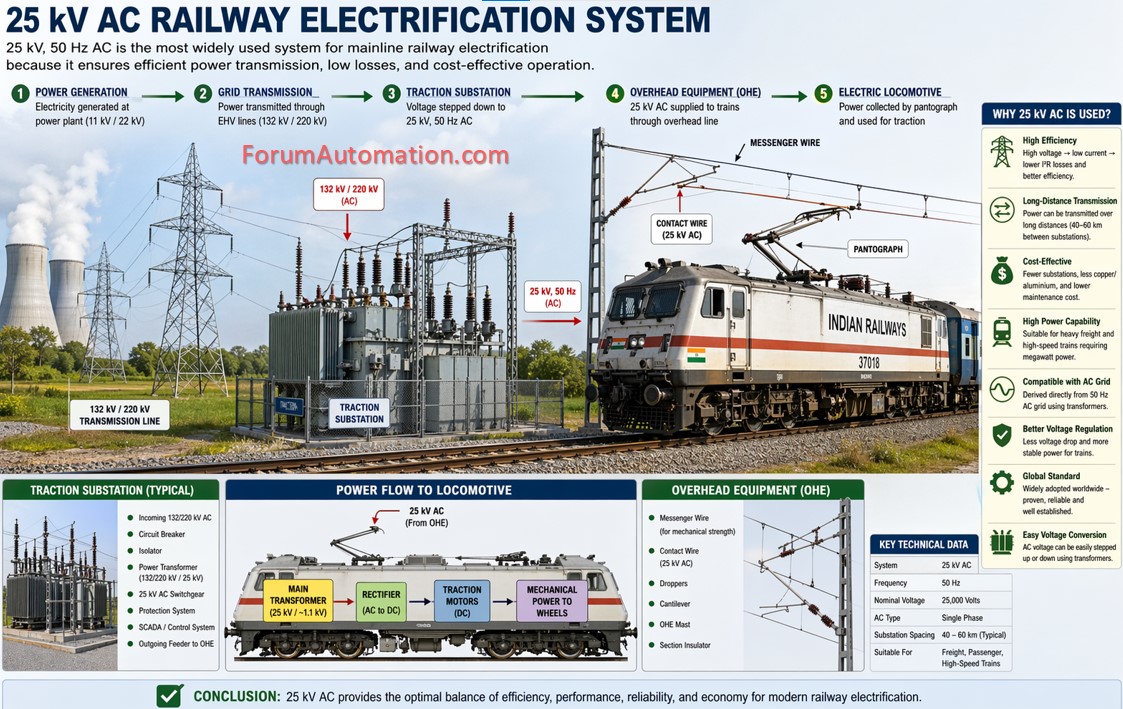
This generated power forms the primary source of energy for the entire system. Since trains require large amounts of power for operation especially in high-speed and freight applications that the generated electricity must be efficiently transmitted over long distances to railway networks.
Grid Transmission
After generation, the voltage is stepped up to high levels such as 132 kV or 220 kV AC for transmission through Extra High Voltage (EHV) lines.
This high-voltage transmission significantly reduces current flow, thereby minimizing I²R losses and improving overall efficiency.
It allows bulk power to be transferred economically over long distances from power plants to railway substations.
Traction Substation
The traction substation plays a crucial role in railway electrification. Here, the incoming high voltage (132 kV or 220 kV) is stepped down to 25 kV AC using power transformers.
The substation is equipped with essential components such as circuit breakers, isolators, protection systems and control equipment to ensure safe and reliable operation.
This is the point from which power is supplied directly to the overhead equipment feeding the trains.
Overhead Equipment (OHE)
The overhead equipment is responsible for delivering 25 kV AC power to the trains. It consists of a messenger wire that provides mechanical support and a contact wire that carries the electrical current.
Droppers connect these wires to maintain proper spacing and tension. Insulators and supporting structures like masts ensure safety and stability. This system ensures continuous and efficient power transfer to moving trains.
Electric Locomotive
The electric locomotive receives power from the overhead system through a device called a pantograph, which maintains contact with the contact wire.
The collected 25 kV AC supply is then processed inside the locomotive. Since traction motors require lower voltage, the power is stepped down and conditioned before being used for propulsion.
Power Flow inside Locomotive
Inside the locomotive, the 25 kV AC supply collected by the pantograph is first passed through a main transformer which reduces the voltage to a lower level suitable for equipment operation.
The reduced AC voltage is then converted into DC using a rectifier (in conventional systems) or processed using modern power electronics.
This electrical energy is finally supplied to traction motors, which convert electrical energy into mechanical energy to drive the wheels of the train.
Key Technical Data
The standard railway electrification system operates at 25 kV AC with a frequency of 50 Hz.
It typically uses a single-phase AC supply.
Traction substations are usually spaced about 40 to 60 kilometers apart, depending on load and route conditions.
This system is suitable for all types of railway operations, including freight, passenger, and high-speed trains.
Why 25 kV AC is Used?
The 25 kV AC system is preferred because it offers high efficiency due to lower current and reduced transmission losses.
It enables long-distance power transmission with fewer substations, making it cost-effective.
The system can handle high power demands required for heavy and fast trains.
It is also compatible with standard AC power grids, ensuring easy integration.
Additionally, it provides better voltage regulation and has become a globally accepted standard in railway electrification.
Overall System Flow
Power Plant → Transmission Line → Traction Substation → Overhead Wire → Pantograph → Locomotive → Wheels