Which is better, DCS or SCADA?
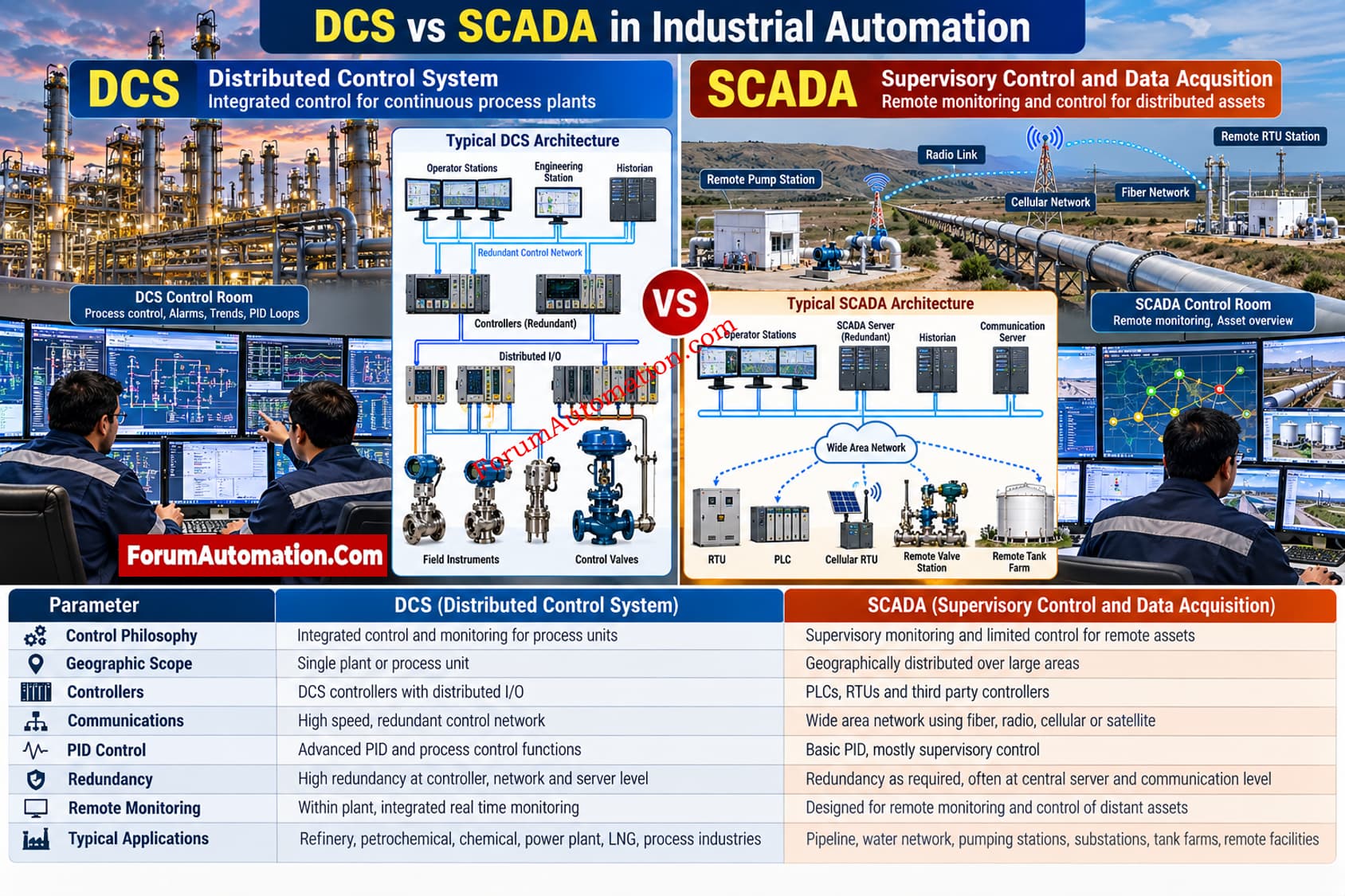
Which is Better, DCS or SCADA?
There is no universal answer to whether DCS or SCADA is better. The correct choice depends on process type, geographic distribution, control requirements, communications and reliability expectations.
When DCS fits
A Distributed Control System is designed for integrated, continuous process control within a plant. It is commonly applied in refineries, petrochemical units, chemical plants, power generation and facilities with many interacting PID loops. Controllers execute control functions locally, while operator stations provide integrated graphics, alarms, trends, historian functions and engineering tools.
When SCADA fits
SCADA is designed mainly for supervisory monitoring and control of geographically distributed assets. It commonly collects data from PLCs and RTUs at remote stations such as pipelines, water networks, substations and pumping facilities. Communication may use radio, cellular, satellite or fiber networks.
Engineering selection
Consider these questions before choosing:
- Is the process continuous and tightly coupled, or mainly remote and distributed?
- Are deterministic closed loop control and extensive redundancy required?
- Will communication links be intermittent or bandwidth limited?
- Are multiple PLC and RTU platforms already installed?
For a refinery process unit with closely related control loops, DCS architecture is commonly selected. For a pipeline with remote valve stations spread across hundreds of kilometers, SCADA is commonly more suitable. Hybrid architectures are also practical, with DCS controlling the local process and SCADA providing higher level visibility across remote facilities.
Therefore, compare architecture, lifecycle engineering, cybersecurity, redundancy, communications and expansion requirements rather than selecting a system based only on software cost.