What types of inputs can be connected to a PLC?
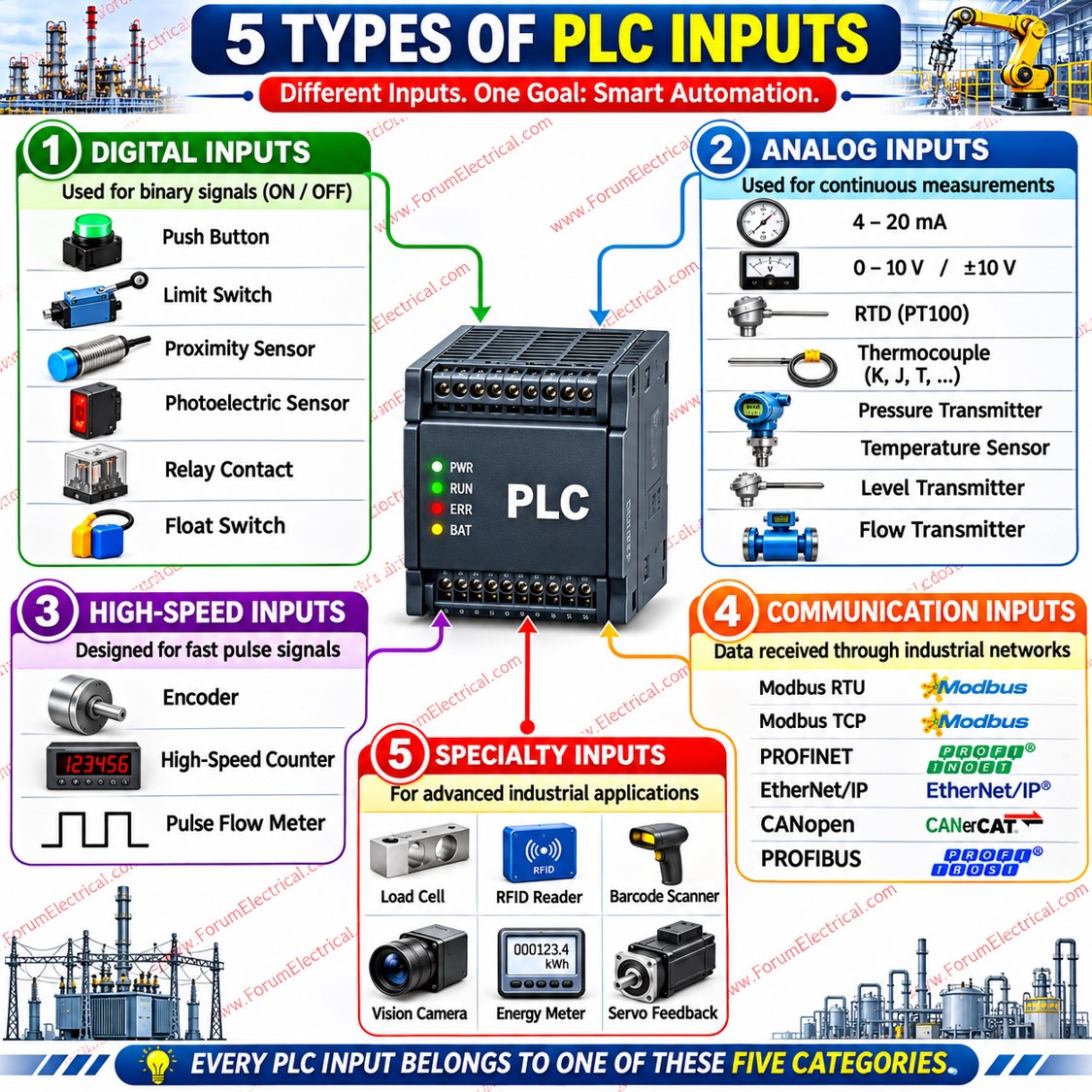
A Programmable Logic Controller (PLC) receives process data through different input interfaces for monitoring, control, and industrial automation.
1. Digital Inputs (DI)
Receive discrete ON/OFF signals from push buttons, limit switches, proximity sensors, photoelectric sensors, and float switches.
2. Analog Inputs (AI)
Measure continuous signals such as 0–10 V, ±10 V, 4–20 mA, and 0–20 mA. RTDs and thermocouples require compatible input modules or signal transmitters.
3. High-Speed Inputs (HSC)
Capture high-frequency pulses from incremental encoders, pulse flow meters, and position feedback devices for counting and speed measurement.
4. Communication-Based Inputs
Receive process data through industrial communication protocols such as Modbus RTU/TCP, PROFINET, EtherNet/IP, EtherCAT, CANopen, and PROFIBUS.
5. Specialty Inputs
Use dedicated interfaces or compatible communication modules for load cells, RFID systems, barcode scanners, machine vision systems, energy meters, and servo feedback.
Technical Note: Input compatibility depends on the PLC model, module specifications, signal type, voltage/current range, resolution, isolation, and communication protocol.