What protocol does Allen Bradley PLC use?
What Protocol Does Allen Bradley PLC Use?
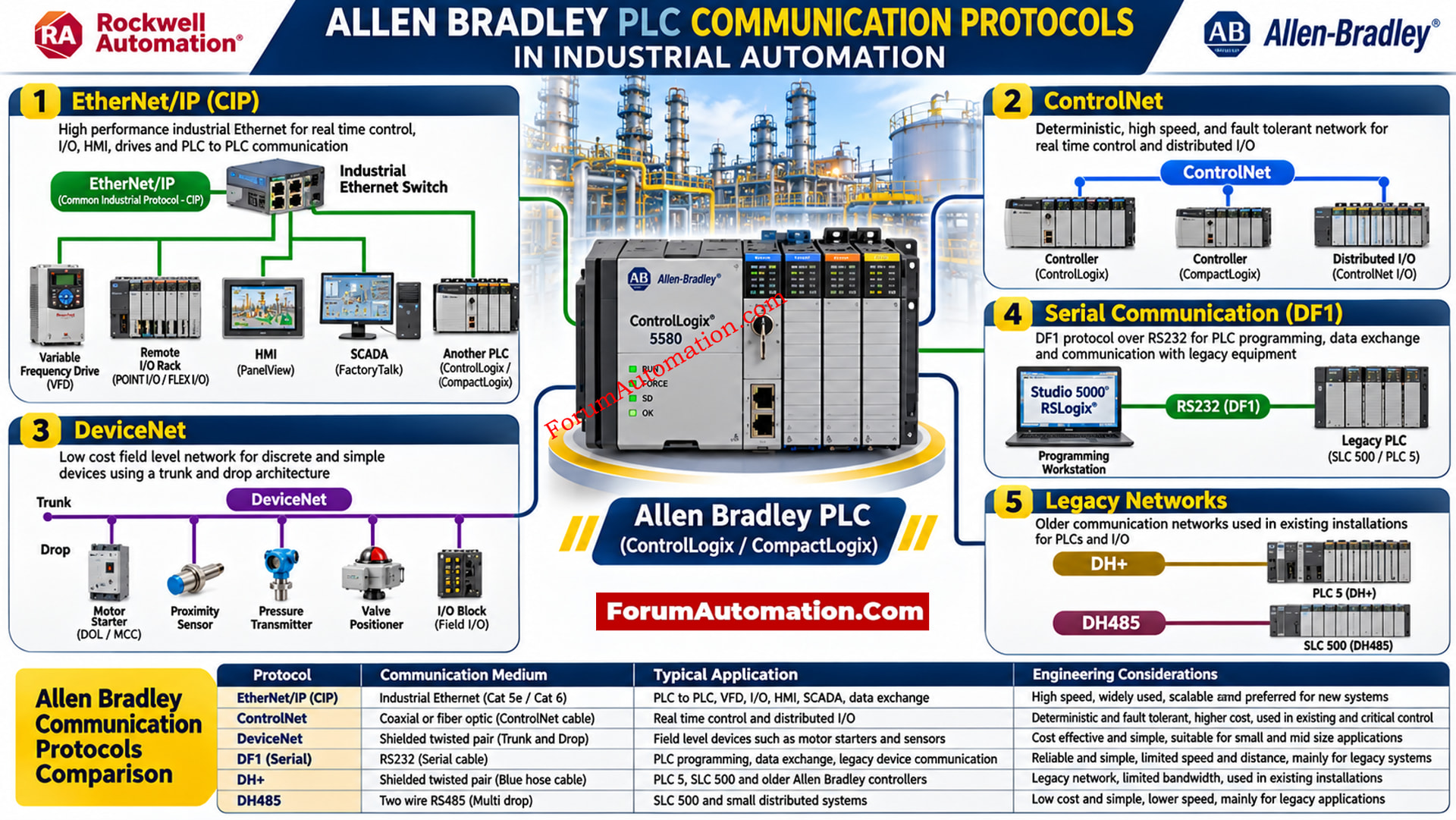
Allen Bradley PLCs primarily use EtherNet/IP for modern industrial communication. However, the protocol depends on the controller family, communication module, firmware, and connected equipment.
Common Allen Bradley Communication Protocols
-
EtherNet/IP: The widely used modern protocol. It carries Common Industrial Protocol (CIP) over Ethernet and supports PLC messaging, remote I/O, drives, HMIs, and SCADA.
-
ControlNet: A scheduled network used in established systems requiring predictable communication between controllers and distributed devices.
-
DeviceNet: A device level network traditionally connecting sensors, motor starters, drives, and field devices.
-
DF1: A serial protocol found in legacy systems using RS232 interfaces.
-
DH+ and DH485: Older networks encountered in existing PLC5 and SLC installations.
-
Modbus RTU or TCP: Certain controller families support Modbus directly; others need suitable modules or gateways.
Which Protocol Should Engineers Select?
For new ControlLogix or CompactLogix installations, EtherNet/IP is generally preferred when supported by the hardware.
Consider these factors:
-
Controller and module compatibility.
-
Required update rate and network loading.
-
Cable distance and topology.
-
Device interoperability and available drivers.
-
Cybersecurity and diagnostics.
Practical Plant Example
A CompactLogix PLC communicating with a variable frequency drive, remote I/O rack, and operator HMI can use EtherNet/IP. Engineers configure device addresses, connection parameters, and communication paths.
Important: Allen Bradley does not use one universal protocol across every PLC. Verify the controller catalog number and supported communication options before designing or troubleshooting a network installation in the plant.