What is voltage of earth?
Ideal earthing (neutral-to-earth) voltage should be below 2 volts, with under 5 volts considered acceptable in most residential setups.
A reading between phase and earth should be nearly identical to the phase-neutral voltage (e.g: 230V or 120V).
Higher voltages indicate
- Improper earthing,
- Overloaded neutrals (or)
- Faulty equipment.
Earthing Voltage
Standards: Ideal: (0V - 2V)
Neutral to Earth)Acceptable: (<5V) (Many standards consider anything under (5V) fine)
Problematic: (>5V) to (10V+) (Needs inspection)
Phase-to-Earth: Similar to Phase-to-Neutral (e.g: 230V in a 230V system).
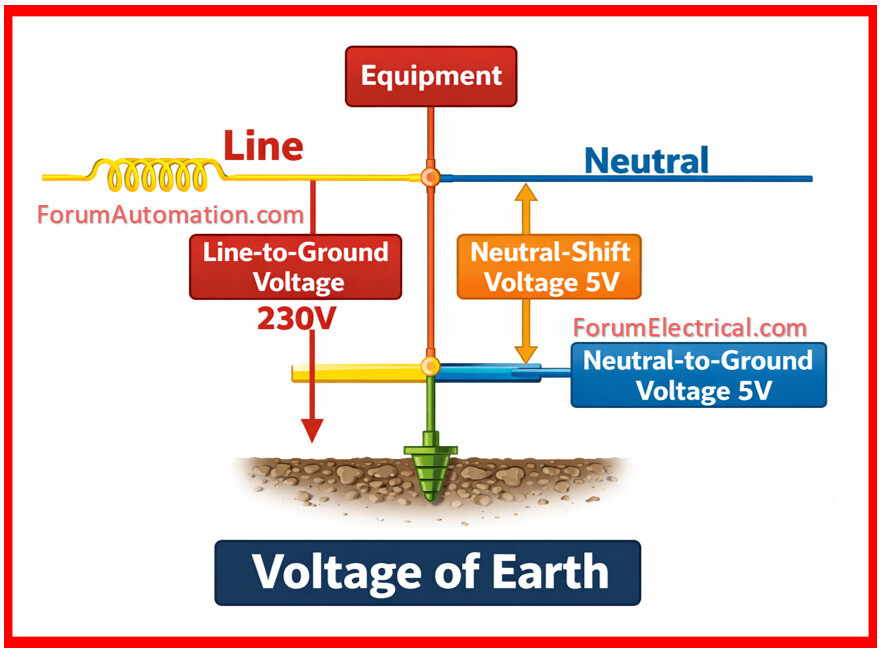
What is Earth Voltage?
Earth voltage refers to the electric potential associated with the earth electrode system that can rise to kilovolts during fault conditions potentially affecting surrounding services and equipment.
Why is Earth’s Voltage Zero?
The Earth has a lot of negative charge and also a lot of positive charge: it’s close to neutral.
Because it is very large adding a small bit of either positive (or) negative charge has little effect.
It is also conductive so any charge added to it spreads out. It is easy as an everywhere accessible reference point.