What is the ZIP Load Model in Power Systems?
The ZIP Load Model is a widely used mathematical model in power system studies to represent how electrical loads respond to changes in supply voltage.
It combines 3 load characteristics
- Constant Impedance (Z),
- Constant Current (I) and
- Constant Power (P)
to simulate real world load behavior more accurately.
Constant Impedance (Z)
In a constant impedance load, current changes directly with voltage.
As the supply voltage decreases, the current also decreases causing the power consumption to reduce.
Constant Current (I)
A constant current load maintains nearly the same current even when the voltage changes.
The power consumed varies in proportion to the applied voltage.
Constant Power (P)
A constant power load attempts to maintain the same power output regardless of voltage variations.
When the voltage drops, the load draws more current making this model common for electronic devices and variable-speed drives.
Why is the ZIP Load Model Important?
The ZIP Load Model improves the accuracy of
- Load flow,
- Voltage stability and
- Dynamic power system studies.
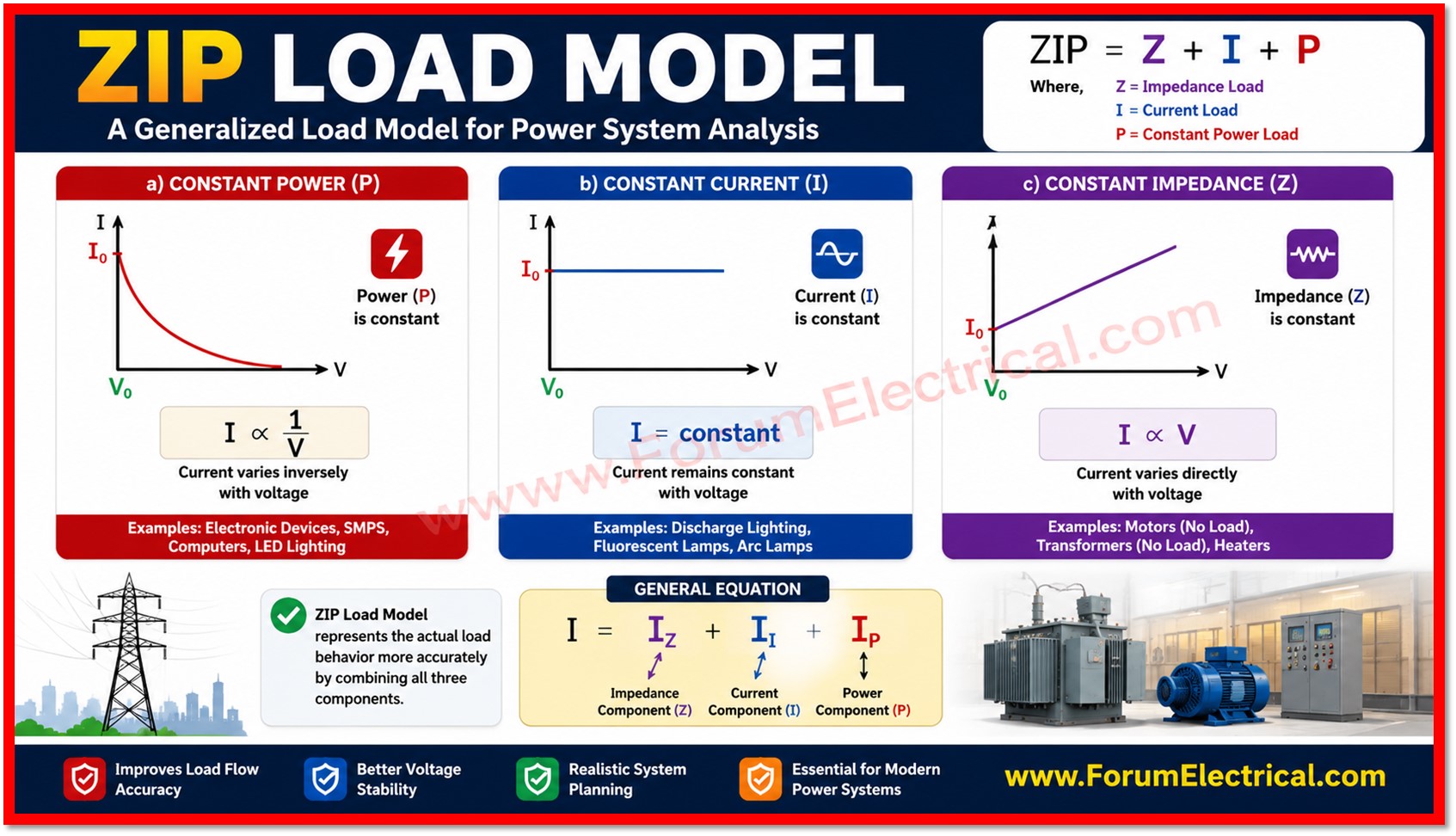
It helps engineers analyze system performance, optimize network planning, and ensure reliable operation under varying voltage conditions.
The ZIP model represents electrical loads as a combination of:
Z - Constant Impedance: Current varies proportionally with voltage (I ∝ V).
I - Constant Current: Current remains unchanged despite voltage variations.
P - Constant Power: Current increases as voltage decreases to maintain constant power (I ∝ 1/V).