What is the triad of OT cybersecurity?
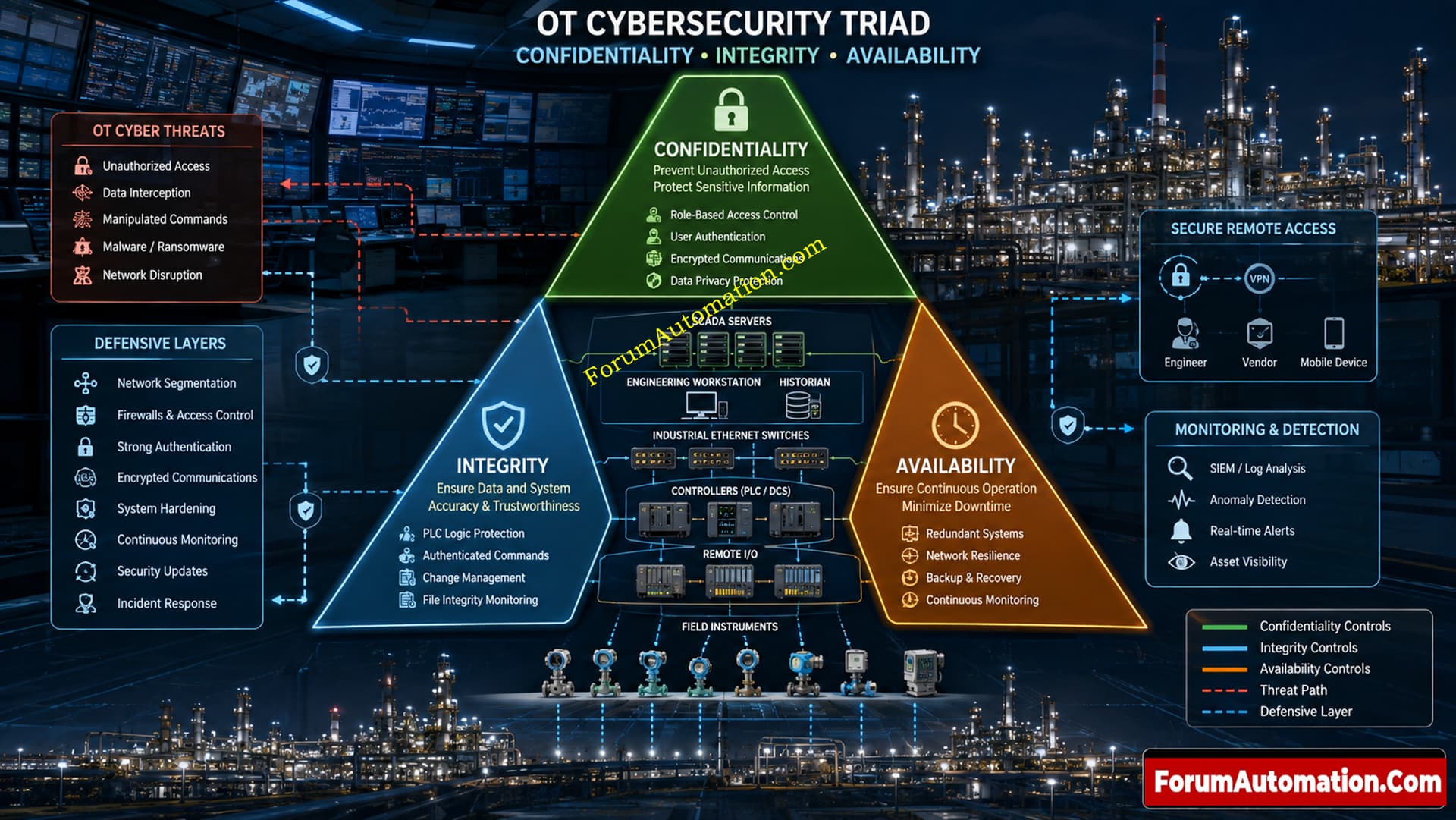
What Is the Triad of OT Cybersecurity?
OT Cybersecurity Triad
The triad applied to OT cybersecurity is the CIA triad. CIA stands for: Confidentiality, Integrity and Availability. It provides a framework for protecting industrial control systems including PLCs, DCS, SCADA, HMIs, engineering workstations, historians and industrial networks. These are the NIST’s pillars of information security. In OT however, their actual emphasis can be different from conventional IT as continuity in production and safe operation are crucial.
1. Confidentiality
Confidentiality means important OT information is unavailable to unauthorized parties. Examples are control logic, network diagrams, process data, engineering credentials, alarm setups and plant information. Confidentiality helps protect: access control, segmentation, authentication, controlled remote access.
2. Integrity
Integrity means that process data, PLC programs, configuration files, commands and communications cannot be inappropriately altered. An attacker could change a valve command or PLC setpoint and cause a significant process upset . Even if the system is still available . Integrity Backed by secure configuration management, authentication, monitoring and network restrictions.
3. Availability
Availability ensures that the operators and controllers have access to the systems that are required to operate the plant safely and reliably. This is important for OT since an incident that stops a PLC, DCS server or network switch can impact production and potentially safety.
Field Perspective
An engineers at a refinery or wastewater facility should consider the principles together. Maintain confidentiality, prevent unauthorized changes, and ensure availability of vital control functions. NIST and the UK NCSC underline the importance of customizing cybersecurity measures to the operational needs of OT, not only implementing IT rules without change. This balanced approach is at the heart of modern OT cybersecurity practice.