What is the purpose of Line Fault Analyzer?
A Line Fault Analyzer is a diagnostic tool used to detect, locate and analyze faults (short circuits, open circuits or insulation failures) in electrical power transmission and distribution lines.
It improves uptime, reduces repair time and prevents damage by identifying abnormal points such as through Line Signature Analysis.
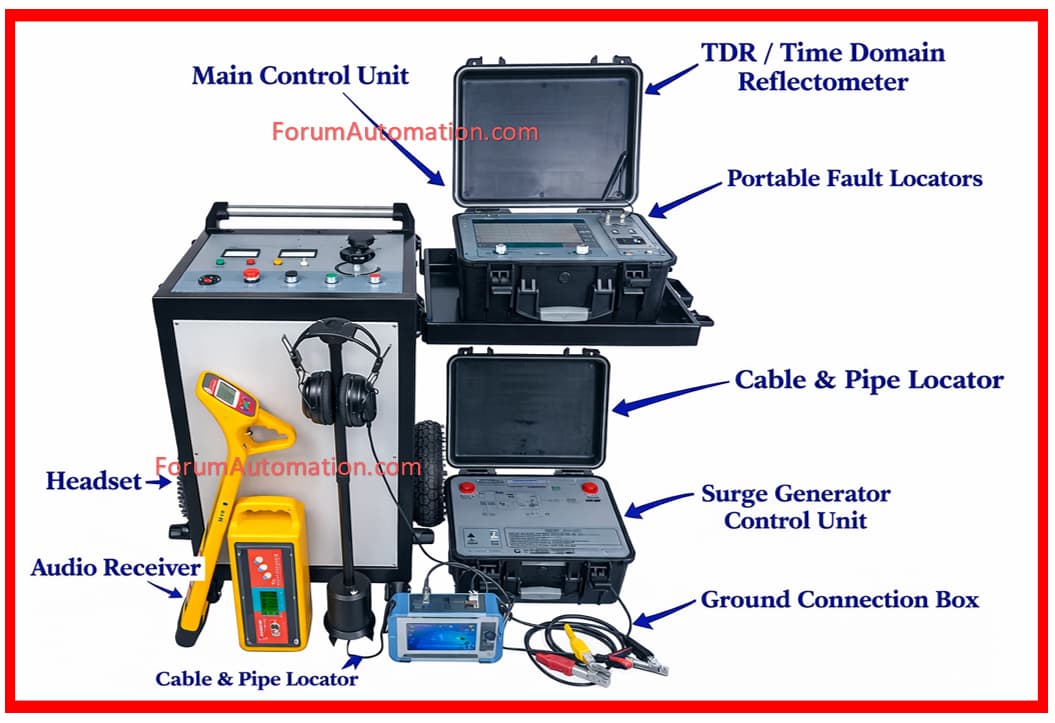
Importance of Line Fault Analyzer
Fault Localization
Accurately detects the location of faults to within a high degree of accuracy (e.g., +/- 100 meters).
Types of Faults Detected
Detects
- Line-to-Ground (L-G),
- Line-to-Line (L-L),
- Double Line-to-Ground (L-L-G) and
- Open Conductor faults.
Line Signature Analysis
It evaluates the health of the line identifying weak points (or) damage without needing full length physical patrolling.
Application
It is used in commissioning new overhead lines (checking continuity and phase sequence), and for troubleshooting in substations.
Types of Analyzers
It includes portable hardware systems for field use and software tools (e.g., in ETAP) for simulating and analyzing grid faults.
Typical Application
- Used for maintaining high voltage (HV) and distribution lines, ensuring minimum downtime.
- Rapidly identifying broken lines after environmental damage.
- Troubleshooting power systems to protect equipment from damage.
These systems such as Taurus MAX-3 (or) other overhead distribution line analyzers are essential for maintaining the integrity of electrical infrastructure especially during, for example, a 3-phase fault (LLL) condition.