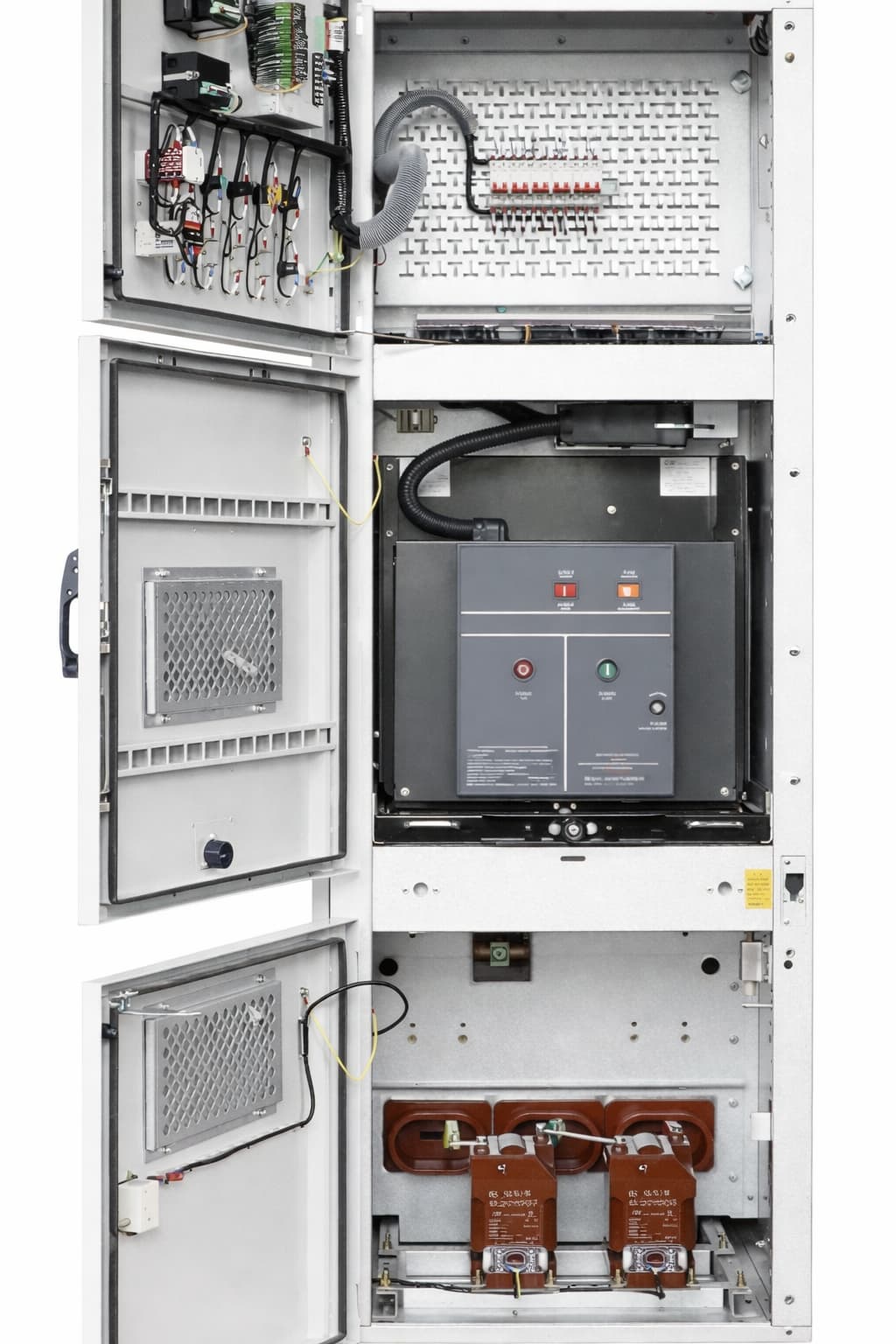
In LV (Low Voltage) and MV (Medium Voltage) panels,
-
Potential Transformers (PTs)
are primarily utilized for measurement, protection and electrical isolation.
A Current Transformer (CT) steps down high line current to a lower standardized value (typically 1A or 5A) so that it can be safely measured by instruments such as ammeters and energy meters and also supplied to protection relays for detecting faults like
Similarly, a Potential Transformer (PT) also known as a Voltage Transformer (VT) steps down high system voltage to a safe level (commonly 110V or 63.5V) for accurate voltage measurement and for use in protective relays and synchronization systems.
Both CTs and PTs provide isolation between high voltage (HV) power circuits and low voltage (LV) control / metering circuits ensuring safety of equipment and personnel while enabling a accurate monitoring and reliable operation of protection schemes in electrical panels.
How to select the correct CT and PT for 110 kV Power Systems?
Selecting the correct Current Transformer (CT) and Potential Transformer (PT) for a 110 kV power system is essential for accurate metering, protection, system monitoring, and safe operation.
The selection should be based on the system voltage, load current, fault level, protection requirements, accuracy class, burden, and insulation level.
Current Transformer (CT) Selection
A Current Transformer (CT) is used to reduce high primary currents to standard secondary values (1 A or 5 A) for meters and protection relays.
1. Determine the Maximum System Current
The CT primary current rating should be selected based on the maximum expected load current of the circuit.
For example:
- If the maximum load current is 450 A, a CT ratio of 600/1 A or 600/5 A may be selected.
- The CT should operate without saturation during normal loading conditions.
2. Select the CT Ratio
The CT ratio should closely match the expected operating current while allowing future load growth.
Common CT ratios for 110 kV systems include:
- 200/1 A
- 400/1 A
- 600/1 A
- 800/1 A
- 1200/1 A
- 2000/1 A
3. Choose the Accuracy Class
The accuracy class depends on the application.
For Metering:
- Class 0.1
- Class 0.2
- Class 0.2S
- Class 0.5
For Protection:
- 5P10
- 5P20
- 10P10
- 10P20
- PX
- TPS
- TPX
- TPY
- TPZ
4. Select the Burden
The CT burden must be sufficient to supply:
- Energy meters
- Protection relays
- Indicating instruments
- Wiring losses
Typical burdens:
- 10 VA
- 15 VA
- 30 VA
- 60 VA
5. Check the Short-Time Current Rating
The CT must withstand the maximum fault current of the system.
Typical ratings:
- 25 kA for 1 second
- 31.5 kA for 1 second
- 40 kA for 1 second
6. Select Insulation Level
For 110 kV systems, the CT insulation level should comply with IEC standards.
Typical values:
- System Voltage: 110 kV
- Highest System Voltage: 123 kV
- Lightning Impulse Withstand Voltage (LIWV): 550 kVp
- Power Frequency Withstand Voltage: 230 kV
Potential Transformer (PT) Selection
A Potential Transformer (PT) or Voltage Transformer (VT) is used to step down high system voltage to a standard secondary voltage for metering and protection.
1. Select the Primary Voltage Rating
The PT primary voltage should match the system voltage.
For a 110 kV system:
- Nominal Voltage = 110 kV
- Highest Voltage = 123 kV
Typical PT ratio:
110 kV / √3 : 110 V / √3
or
110000 V / 110 V
depending on the application.
2. Select the Secondary Voltage
Standard PT secondary voltages include:
- 110 V
- 63.5 V
- 100 V
The most common value in substations is:
110 V or 63.5 V
3. Select the Accuracy Class
For Metering:
- 0.1
- 0.2
- 0.5
For Protection:
- 3P
- 6P
4. Select the Burden
The PT burden must cover:
- Energy meters
- Protection relays
- Indication meters
- Transducers
Typical burdens:
- 30 VA
- 50 VA
- 100 VA
- 200 VA
5. Select the Insulation Level
For a 110 kV system, the PT insulation level should match the system requirements.
Typical values:
- Highest System Voltage: 123 kV
- Lightning Impulse Withstand Voltage: 550 kVp
- Power Frequency Withstand Voltage: 230 kV
Typical CT and PT Selection for a 110 kV Line Bay
| Parameter | CT | PT |
|---|---|---|
| System Voltage | 110 kV | 110 kV |
| Highest System Voltage | 123 kV | 123 kV |
| Ratio | 800/1 A | 110 kV/√3 : 110 V/√3 |
| Accuracy Class | 0.2S / 5P20 | 0.2 / 3P |
| Burden | 15 VA – 30 VA | 50 VA – 100 VA |
| Frequency | 50 Hz | 50 Hz |
| Short-Time Current | 31.5 kA, 1 sec | As per system requirement |
| Insulation Level | 123 kV, 550 kVp BIL | 123 kV, 550 kVp BIL |
Conclusion
The correct CT and PT selection for a 110 kV power system should be based on the system voltage, maximum load current, fault level, accuracy requirements, burden, insulation level, and intended application. Metering CTs and PTs require high accuracy, while protection CTs and PTs must remain reliable under fault conditions. Proper selection ensures accurate measurements, dependable protection operation, and long-term reliability of the substation equipment.