What is the principle of CO analyzer?
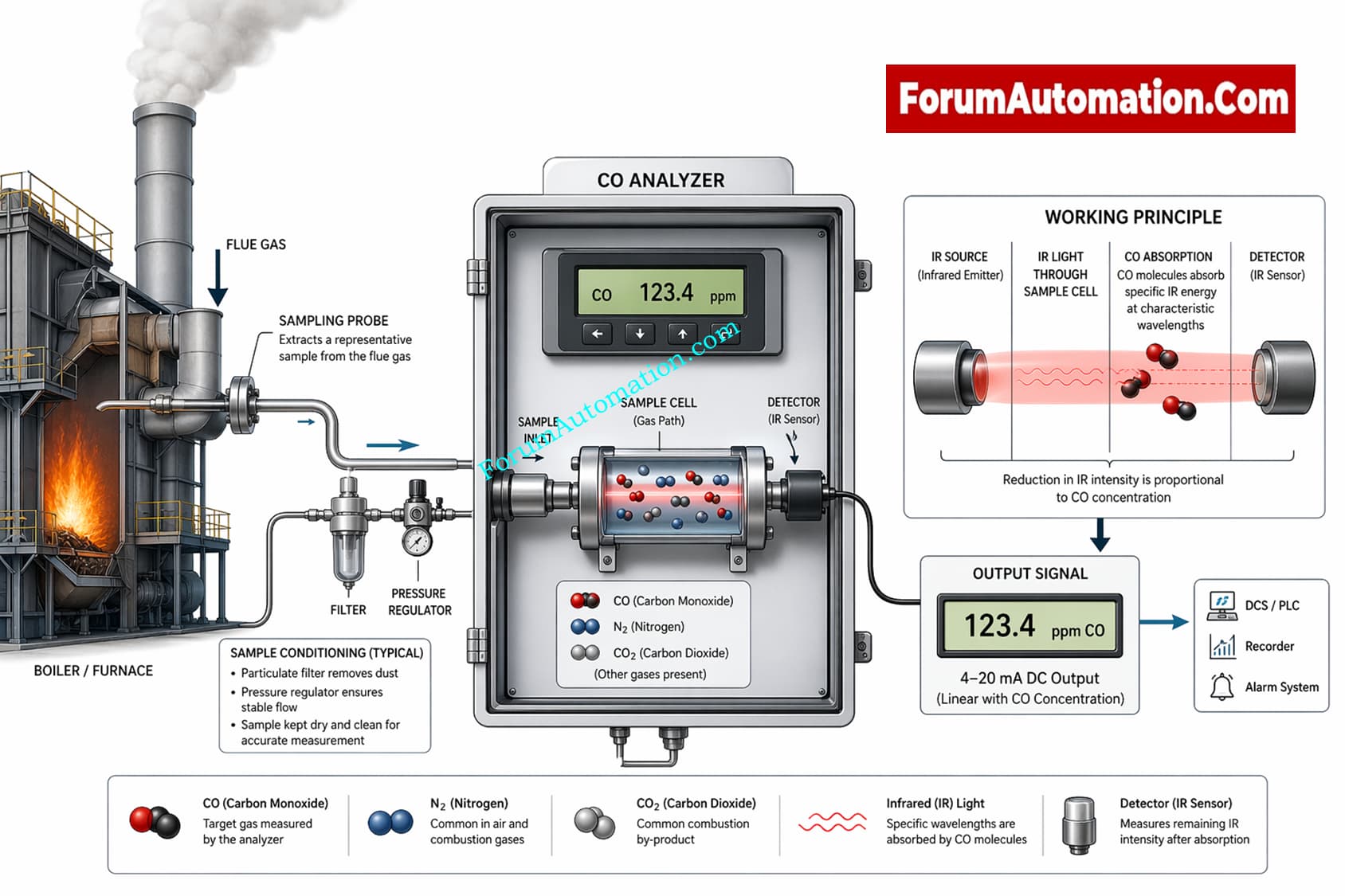
What is the principle of CO analyzer
Principle
Most of the time, a carbon monoxide analyzer in a process plant works on the non-dispersive infrared concept. At a certain wavelength, CO molecules take in infrared radiation, and the amount they take in vary with the concentration of the gas. An IR source distributes energy via a sample cell, and the CO in the gas absorbs some of that energy. The detector then turns the rest of the signal into a ppm reading. This is the same idea behind molecule selective absorption that is utilized in systems that analyze industrial gases.
Where it is used
The CO analyzer enables people who run boilers, furnaces, incinerators, and flue gas systems figure out how well the combustion is working. Even if the unit looks okay on the outside, low surplus air, an unbalanced burner, bad mixing, or an unstable flame might cause CO levels to rise. That’s why CO levels are typically seen as a quick way to tell whether combustion isn’t complete instead of just an emissions quantity.
What engineers should check
In the field, the biggest problems are usually not with the sensor principle itself, but with how samples are handled. Drift or sluggish reaction might happen when there is moisture, dust, clogged filters, leak pathways, the improper calibration gas, or an unsteady sample flow. If the analyzer reads high or unstable, technicians should first check the sample conditioning system, then check the zero and span, and finally check that the optical route is clear and the calibration interval is correct. A well-maintained NDIR CO analyzer is valuable because it delivers reliable, constant feedback on combustion in tough industrial settings.