What is the Pre-Insertion Resistor in a Circuit Breaker?
High-voltage circuit breakers operating at 400 kV employ 2 primary designs that differ in a single essential feature:
1). The presence or absence of a pre-insertion resistor (PIR).
2). Both design variants utilize self-compensating spring-operated mechanisms for opening and closing operations with SF₆ gas serving as the arc-quenching medium at a nominal pressure of 6 bar (gauge).
Pre-Insertion Resistor (PIR)
Function and Operation
A pre-insertion resistor is a fixed resistor with a nominal resistance of 200–400 ohms that is connected into the circuit prior to the closure of the main circuit breaker contacts.
This component is integrated into the breaker operating mechanism and follows a prescribed sequence during switching operations.
Operational Sequence
Closing Operation
• Close command is issued.
• PIR contacts close (establishing the resistive path).
• Interval of 10–12 milliseconds elapses.
• Main breaker contacts close (short-circuiting the PIR).
Opening Operation
• Open command is issued.
• PIR contacts open (removing the resistive path).
• Interval of 10 milliseconds elapses.
• Primary breaker contacts open (interrupting the circuit).
Primary Function
The primary function of the PIR is to limit the inrush (charging) current when energizing circuits with significant capacitive or inductive characteristics.
Long transmission lines which possess substantial series capacitance that produce exceptionally high inrush currents upon energization.
Similarly power transformers exhibit large transient inrush currents during the initial moments of energization.
By establishing a high-resistance path prior to main contact closure the PIR restricts the rate of current rise and reduces the peak magnitude of the inrush current.
Once the main contacts close and establish a low-resistance shunt path, current through the resistor reduces to zero.
The PIR effectively becomes bypassed by the low-impedance main contact.
Application
Breakers equipped with PIR are recommended for use in a long transmission line applications and circuits containing transformers (or) other inductive elements that generate substantial inrush currents.
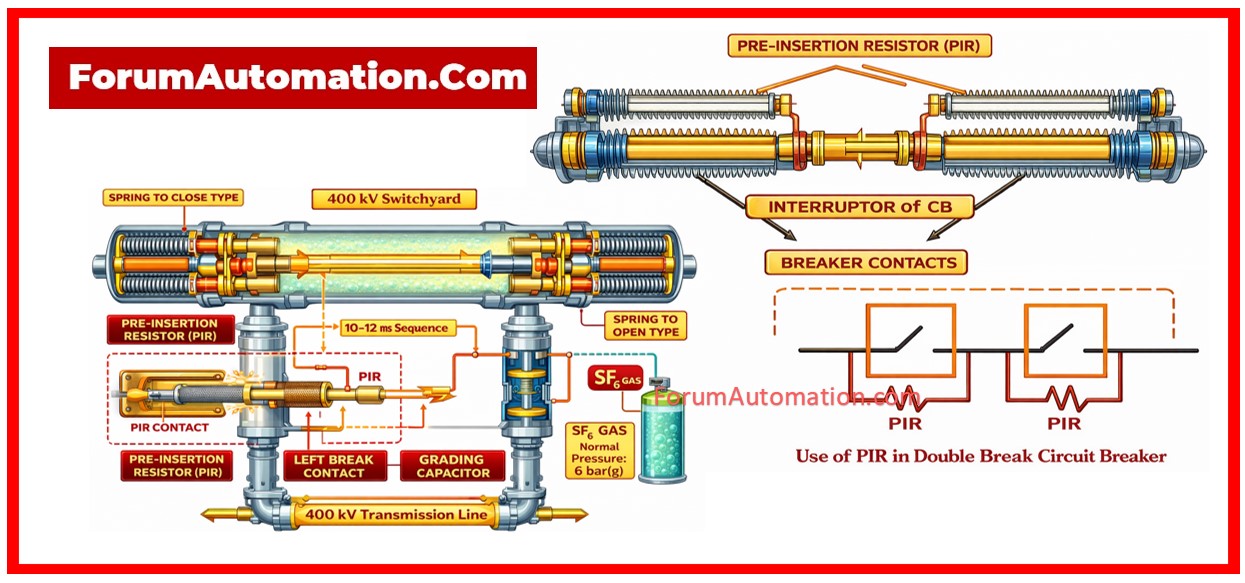
The resistive pre-insertion phase protects both the circuit breaker mechanism and connected equipment from the mechanical and thermal stresses associated with high inrush transients.
You can also follow us on AutomationForum.co, Facebook and Linkedin to receive daily Instrumentation updates.
You can also follow us on ForumElectrical.com , Facebook and Linkedin to receive daily Electrical updates.