What is the main advantage of hydrostatic level sensor type ?
What is the main advantage of hydrostatic level sensor type ?
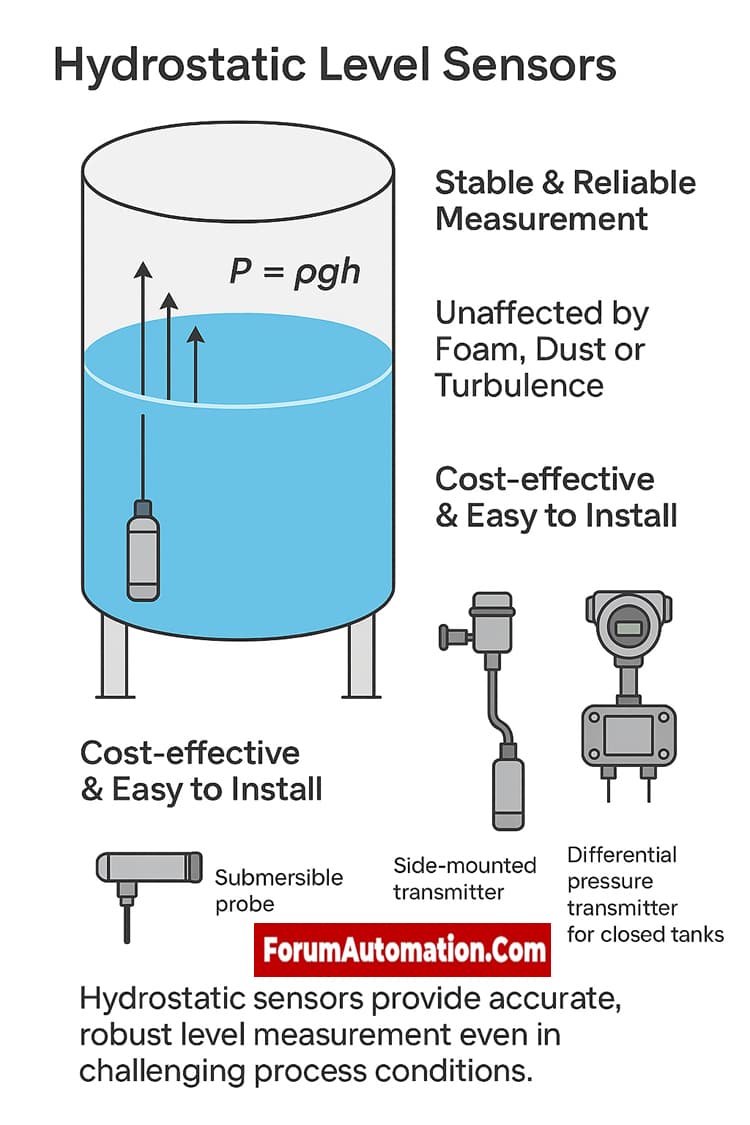
The best thing about hydrostatic level sensors is that they are reliable and stable while sensing liquid levels in many different industrial settings. The basic idea behind hydrostatic level measurement is that the pressure at the bottom of a column of liquid is equal to the height and density of the liquid (P = ρgh). Hydrostatic level sensors can precisely find the level of a liquid if they know its density and can measure this pressure. One of the best things about hydrostatic sensors is that they are quite strong. Hydrostatic sensors are better than other ways to measure levels since they aren’t impacted by foam, dust, turbulence, or changes in viscosity. This makes them good for tough situations with dirty or agitated liquids. They are also cheap and easy to install, and most of the time, existing tanks or pipelines don’t need to be changed much. There are many kinds of hydrostatic sensors, such as submersible, side- or bottom-mounted pressure transmitters, and differential pressure transmitters for closed tanks. This gives you options based on what the process needs. Differential pressure transmitters separate gas pressure in pressurized tanks for accurate measurement, while submersible sensors can be put directly into the liquid.
Hydrostatic level sensors can also be used in many different fields, such as food and beverage, pharmaceuticals, chemical processing, oil and gas, water treatment, and power generation. Their simplicity, along with modern technologies like smart sensors, wireless connection, and data analytics, makes operations more efficient and lets you keep an eye on things from afar. In short, the best thing about hydrostatic level sensors is that they are accurate, reliable, strong, and cheap. This makes them the best choice for measuring liquid levels in both open and closed vessels that stay the same over time, even when the process is hard.