What is the difference between PLC and SIS?
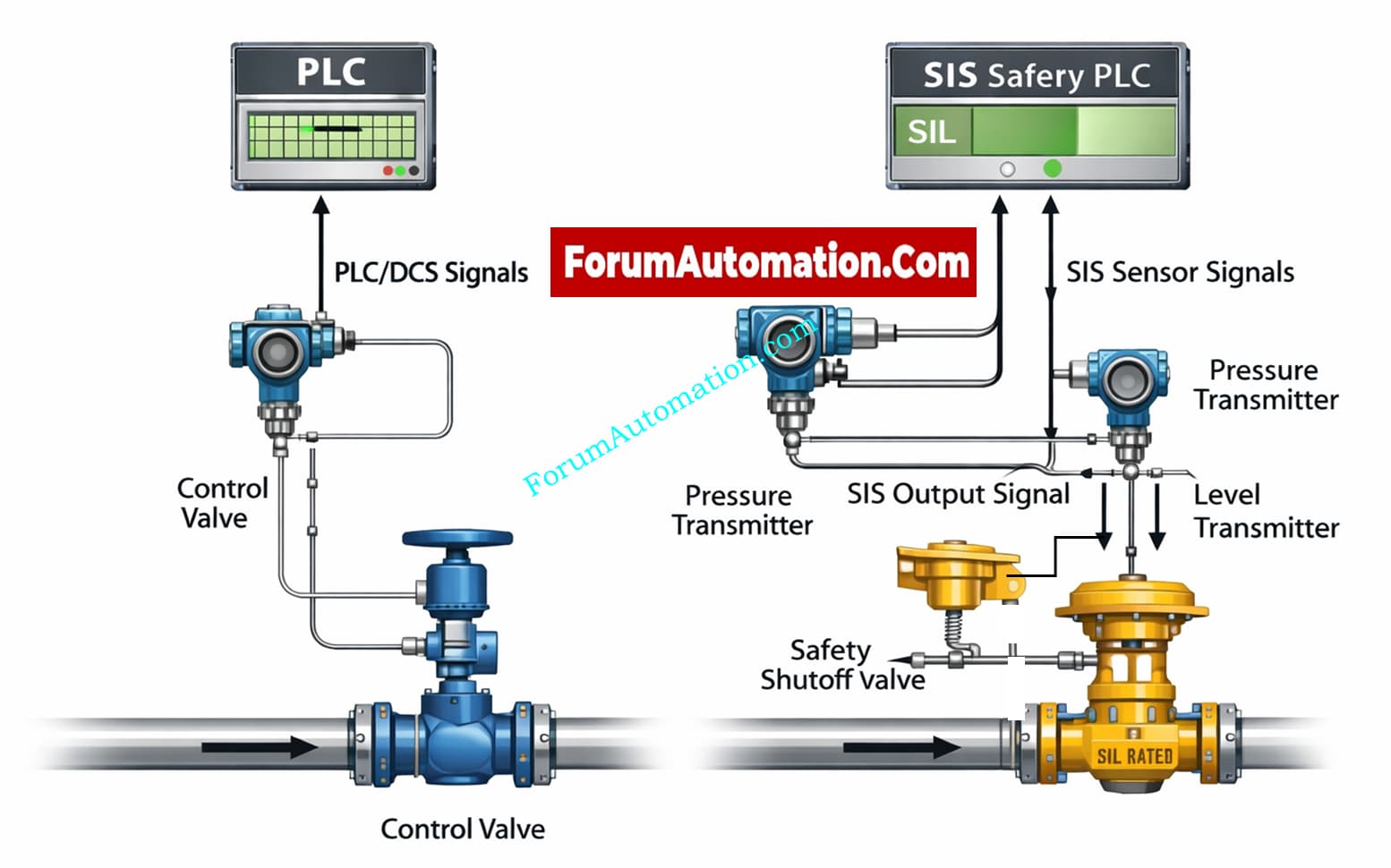
Difference between PLC and SIS
Even though the hardware may seem the same, a Programmable Logic Controller (PLC) and a Safety Instrumented System (SIS) do quite different things in a plant.
PLC systems are used for conventional process control, sequencing interlocks, and automation. They make production better and keep the process stable. SIS is committed to keeping people, the environment, and property safe by transitioning the process to a safe state when conditions are dangerous.
Standard PLCs are not made or tested to satisfy functional safety goals. SIS logic solvers are made and tested to meet functional safety criteria, which include regulated software behaviour diagnostics and fault tolerance.
SIS hardware has internal diagnostics watchdogs and often redundant architectures to find dangerous faults. PLC reliability is fine for control, but not for lowering risk in a measurable way.
The basic process control system and SIS must not be the same thing. If you share power supplies, networks, or input/output without checking them first, your safety promises may not be true. PLCs are usually the most important part of the basic control system.
SIS programs have a tight safety lifecycle that includes finding hazards, assigning SILs, checking and validating them, and doing proof tests. PLC applications usually come after commissioning and operational change control, but not after formal safety lifecycle management.
SIS final parts like shutdown valves or motor trips are chosen based on how reliable they are on demand and how long it takes for the stroke to happen. People mostly choose PLC-controlled gadgets based on how well they can control things.
A safety-rated PLC doesn’t inevitably make a SIS. Only functions that risk analysis has found and that are managed through the safety lifecycle should be called SIS. Clear documentation helps prevent making hazardous assumptions during audits and changes.