What is the difference between KW, KVA and KVAR?
Understanding the difference between kW, kVA and kVAR is essential for power system design, load calculation and improving efficiency especially in industrial and substation applications.
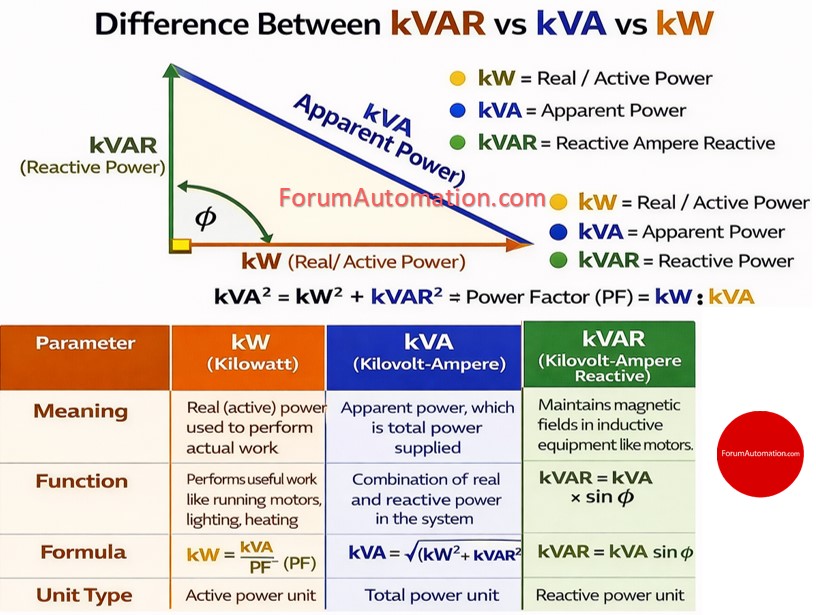
| Parameter | kW (Kilowatt) | kVA (Kilovolt-Ampere) | kVAR (Kilovolt-Ampere Reactive) |
|---|---|---|---|
| Meaning | It represents real (active) power used to perform actual work. | It represents apparent power, which is total power supplied. | It represents reactive power, which does not perform useful work. |
| Function | It performs useful work like running motors, lighting, heating. | It is the combination of real and reactive power in the system. | It maintains magnetic fields in inductive equipment like motors and transformers. |
| Formula | kW = kVA × Power Factor (PF) | kVA = √(kW² + kVAR²) | kVAR = kVA × sinφ |
| Unit Type | Active power unit | Total power unit | Reactive power unit |
| Power Factor Relation | Directly depends on PF | Independent of PF | Depends on phase angle (φ) |
| Measurement | Measured by wattmeter | Measured by voltmeter & ammeter | Measured by VAR meter |
| Application | Used for billing and actual energy consumption | Used for equipment rating (transformers, generators) | Used for power factor correction |