What is the difference between hot loop and cold loop checking?
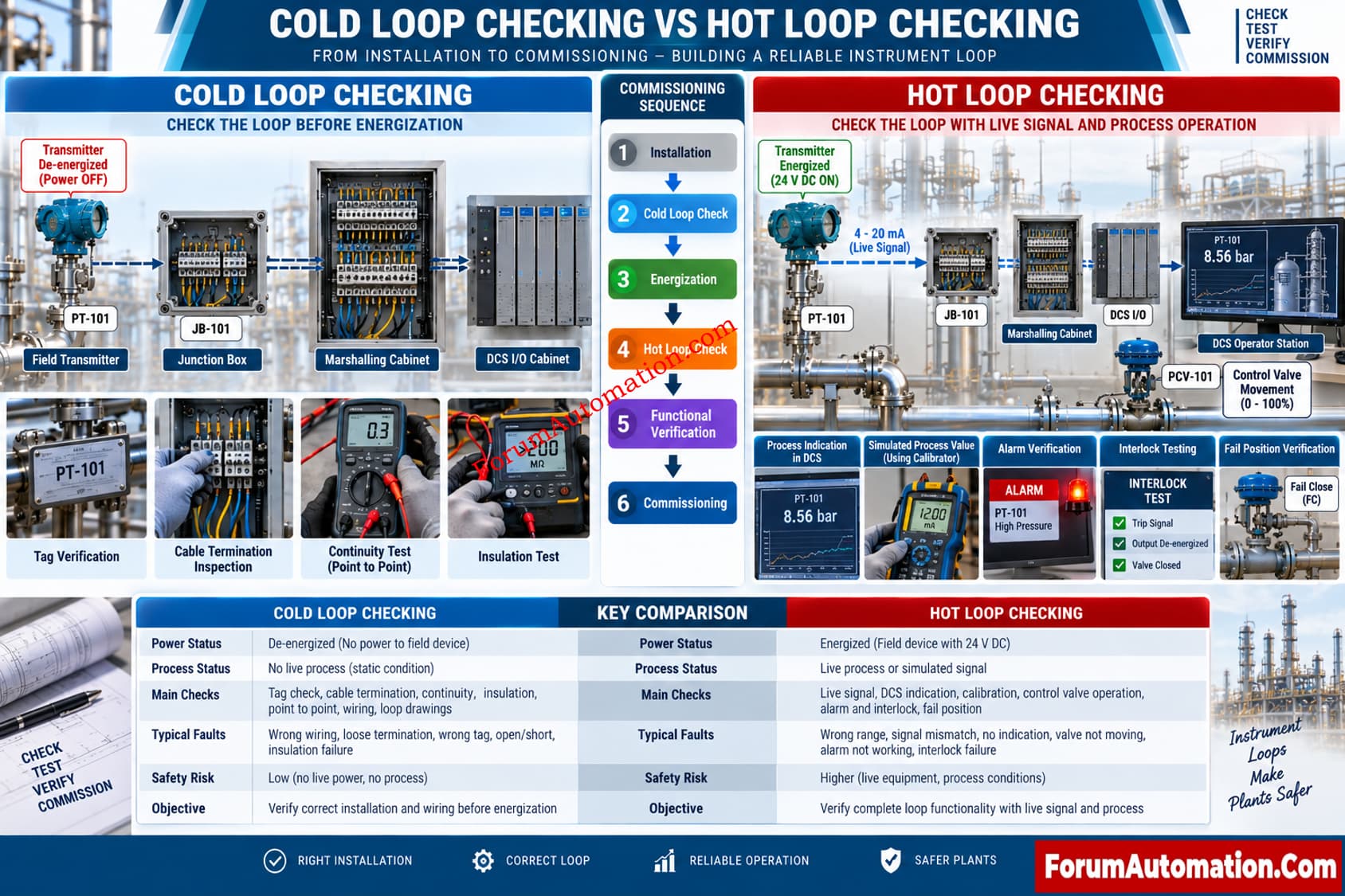
What is the difference between hot loop and cold loop checking?
Hot loop and cold loop checks are tests that validate the instrumentation circuits under different operating circumstances.
Cold Loop Checking
Cold loop checking is done prior to live process activity. It is concerned with physical installation, integrity of wiring, terminal connections, cable continuity, correct I/O channel allocation and tag identification. The field device and loop may be de-energized during the completion of the continuity and point to point checks.
Typical checks include:
- Correct instrument tag and terminal identification
- Cable continuity and termination
- Junction box and marshalling connections
- Correct PLC or DCS I/O channel
- Correct signal path according to drawings
Hot Loop Checking
Hot loop verification is done with the instrumentation system energized and the process available. The engineer checks the functional response and live signal path. The DCS or PLC reading is compared to the simulated or actual process value for an analog transmitter. The control loop may also be checked for controller output, valve response, alarms, interlocks and fail action.
Key Difference
The easiest way to tell is:
Cold loop: Verify installation and signal path before live operation.
Hot loop: Verify live signal transmission and functional performance.
For example, if a pressure transmitter is attached to the wrong DCS input, cold checking can detect the wiring or channel mismatch before energization. Hot checking allows the engineer to verify the transmitter power, measured value, scaling, alarms and control response.
Cold loop inspection shall be accomplished before hot loop testing in accordance with the project commissioning protocol. This procedure decreases the danger of troubleshooting and prevents the wrong outputs from damaging live equipment. This distinction allows commissioning teams to sequence testing, isolate faults and protect equipment during energization and start-up.