Synchronous motors and induction motors are the two most widely used AC motors in industrial and commercial applications. While both convert electrical energy into mechanical energy, they differ significantly in operating principle, speed characteristics, starting method, efficiency, and applications. Understanding these differences helps engineers select the right motor for specific loads and operating conditions.
What Is a Synchronous Motor?
A synchronous motor operates at a constant speed that is exactly synchronized with the supply frequency. Its rotor rotates at the same speed as the rotating magnetic field produced by the stator. The rotor requires DC excitation or permanent magnets to create the magnetic field.
What Is an Induction Motor?
An induction motor, also known as an asynchronous motor, operates by electromagnetic induction. The rotor current is induced by the stator’s rotating magnetic field, allowing the rotor to rotate slightly slower than synchronous speed. This speed difference is known as slip.
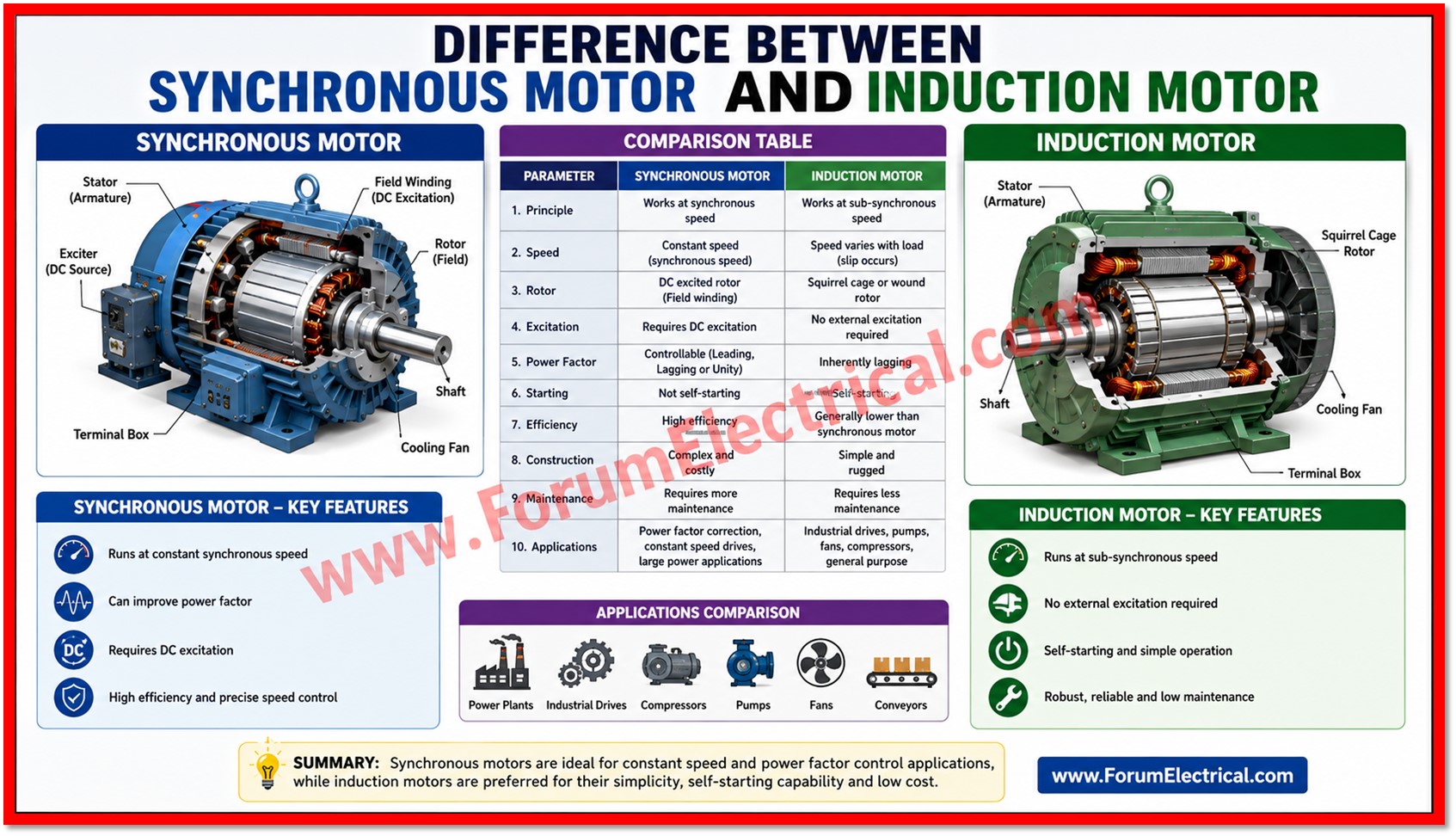
Difference between Synchronous Motor and Induction Motor
| Parameter | Synchronous Motor | Induction Motor |
|---|---|---|
| Operating Principle | Rotor locks with stator magnetic field | Rotor current induced by electromagnetic induction |
| Speed | Runs exactly at synchronous speed | Runs below synchronous speed due to slip |
| Slip | Zero | Always greater than zero |
| Starting | Not self-starting (requires starter or auxiliary method) | Self-starting |
| Rotor Excitation | Requires DC excitation or permanent magnets | No external rotor excitation required |
| Power Factor | Can operate at leading, lagging, or unity power factor | Generally operates at lagging power factor |
| Efficiency | Higher, especially at constant loads | High but generally lower than synchronous motors |
| Speed Regulation | Excellent | Good, but varies slightly with load |
| Construction | More complex | Simpler and rugged |
| Maintenance | Higher due to excitation system | Lower maintenance |
| Cost | Higher initial cost | More economical |
| Common Applications | Compressors, pumps, synchronous condensers, power factor correction | Fans, pumps, conveyors, compressors, machine tools |