What is the difference between 50 Hz power transmission and 60 Hz power transmission?
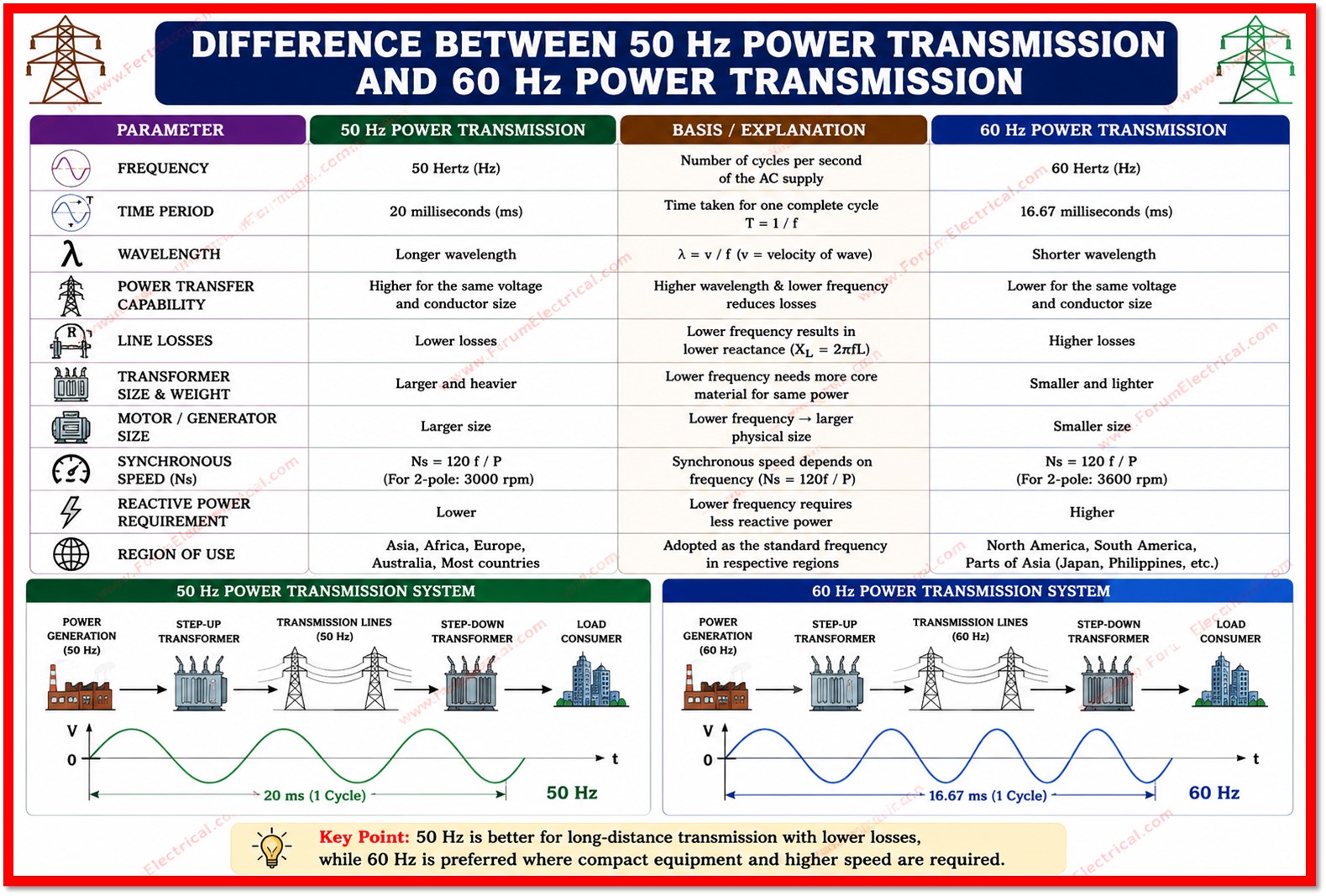
Reference Image Provided by the Respondent
Reference Image Provided by the Respondent
The main difference between 50 Hz and 60 Hz power transmission is the frequency at which alternating current (AC) changes direction every second. A 50 Hz system completes 50 cycles per second, while a 60 Hz system completes 60 cycles per second.
The frequency affects transformer and motor design, transmission efficiency, equipment size, and system performance.
Countries generally standardize on one frequency and electrical equipment must be designed accordingly.
| Parameter | 50 Hz Power Transmission | 60 Hz Power Transmission |
|---|---|---|
| Frequency | 50 cycles per second | 60 cycles per second |
| Countries Using It | Europe, Asia, Africa, Australia | USA, Canada, Mexico, South Korea, parts of South America |
| Transmission Efficiency | Slightly lower for the same conductor | Slightly higher due to reduced transformer size |
| Transformer Size | Larger and heavier | Smaller and lighter |
| Motor Speed | Lower synchronous speed | Higher synchronous speed |
| Synchronous Speed (4-Pole Motor) | 1500 RPM | 1800 RPM |
| Reactance (XL = 2πfL) | Lower inductive reactance | Higher inductive reactance |
| Core Losses | Lower iron losses | Slightly higher iron losses |
| Equipment Cost | Slightly higher due to larger magnetic components | Generally lower for equivalent ratings |
| Power System Standard | IEC-based countries | ANSI/NEMA-based countries |
| Equipment Compatibility | Designed specifically for 50 Hz | Designed specifically for 60 Hz |
| Interchangeability | Not always compatible with 60 Hz equipment | Not always compatible with 50 Hz equipment |