What is the best PID tuning method?
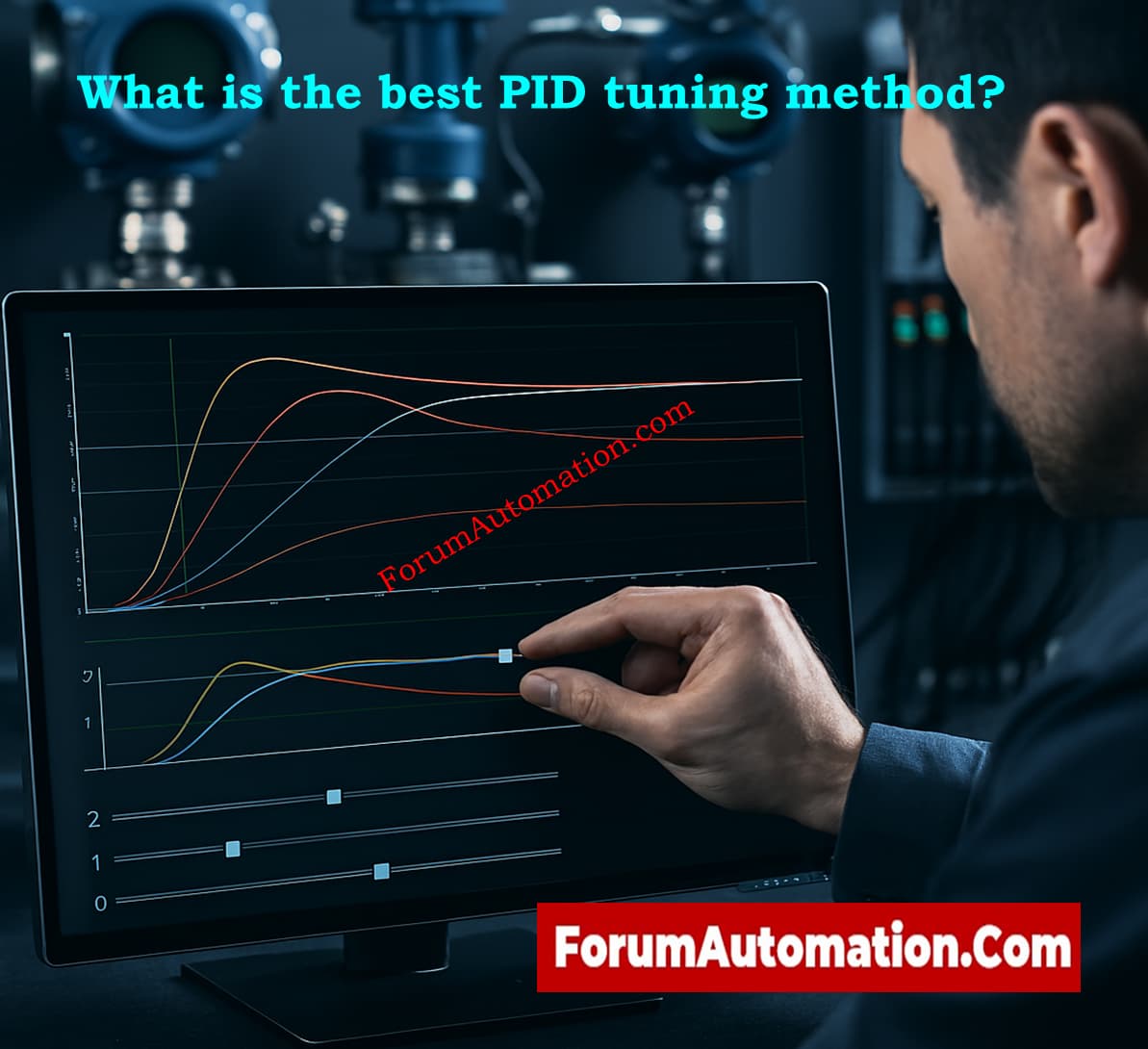
To tune a PID controller (Proportional-Integral-Derivative), you have to choose the gains (P, I, D) such that the control loop works the way you want it to. Historically, classical heuristic approaches like the Ziegler–Nichols method or the Cohen-Coon method have been popular because they are easy to use, don’t need any math modeling, and can be used with just experimental open- or closed-loop response data.
Ziegler–Nichols lets you quickly and roughly tune by setting I and D to 0, raising P until persistent oscillation develops, and then using that “ultimate gain” and oscillation period to figure out P, I, and D. Cohen-Coon, on the other hand, uses an open-loop step response to figure out the process lag and time constant. This makes the settings more balanced when there is a lot of dead time. But both heuristics often lead to excessive overshoot or bad performance in systems that are complicated, nonlinear, or have a lot of delay.
Because of these limits, many control engineers now choose model-based or software-assisted tuning. This means employing tools that make a mathematical (transfer-function or state-space) model of the system and find PID gains that balance responsiveness and robustness. PIDTuner is an example of software that automatically chooses PID parameters based on a plant model or response data. It also lets you change performance criteria like phase margin, bandwidth, or disturbance. rejection vs. tracking the set point Model-based tuning is frequently the “best” way to go in reality, especially for industrial circuits where stability, repeatability, minimal overshoot, and robustness are important. It gives more reliable outcomes, cuts down on trial and error, and works better with complicated dynamics. For simpler loops, classical approaches still give a quick first guess, but model-based tools are usually better for fine-tuning.