What is the 80% rule for generators?
The 80% rule for generators states that a generator should normally be operated at no more than 80% of its rated capacity for continuous use.
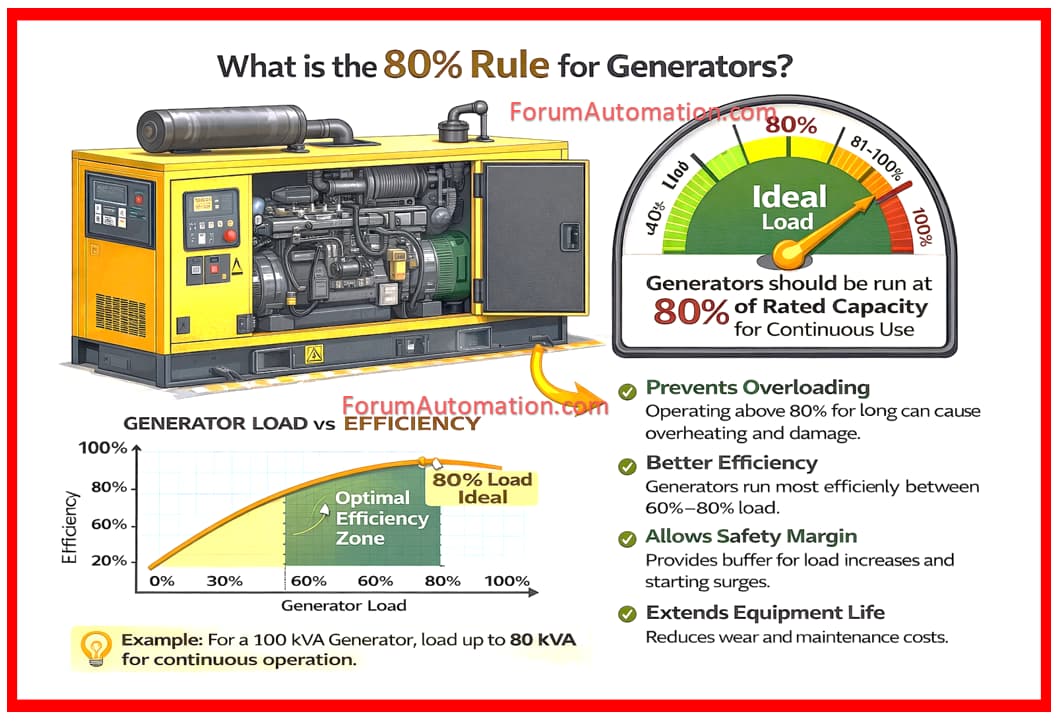
Running a generator at around 80% load ensures:
- Stable operation
- Better fuel efficiency
- Reduced overheating
- Longer equipment life
Example
A 100 kVA generator should ideally be loaded up to 80 kVA for continuous operation.
Why the 80% Rule is Important?
Prevents Overloading
Operating beyond 80% for long periods can cause overheating and insulation damage.
Improves Efficiency
Generators perform most efficiently between 60%–80% load.
Allows Safety Margin
Provides buffer for sudden load increases or starting currents.
Reduces Maintenance Issues
Lower stress on engine and alternator reduces wear and tear.
For standby generators higher loading may be allowed for short durations.
For continuous-duty generators maintaining 70–80% loading is ideal.
Avoid very low loading (<30%) as it can cause wet stacking in diesel generators.
The 80% rule is a practical guideline to ensure safe, efficient and reliable generator operation extending lifespan while maintaining performance.