In a three-phase power system, voltages and currents can become unbalanced due to faults, load imbalance (or) equipment issues.
To analyze such conditions symmetrical components are used.
1). Positive Sequence
Three equal magnitude voltages or currents.
Separated by 120° from each other.
Rotate in the same direction as the original system.
Represents the normal operating condition of the power system.
Eg: In a healthy system, phase voltages Va, Vb, Vc form a balanced positive sequence.
2). Negative Sequence
Three equal magnitude voltages or currents.
Separated by 120 but rotate in the opposite direction of the original system.
Produced during unbalanced faults (like line-to-line or unbalanced loads).
Harmful to motors and generators as it causes additional heating.
Eg: A single-phase-to-ground fault will introduce negative sequence components.
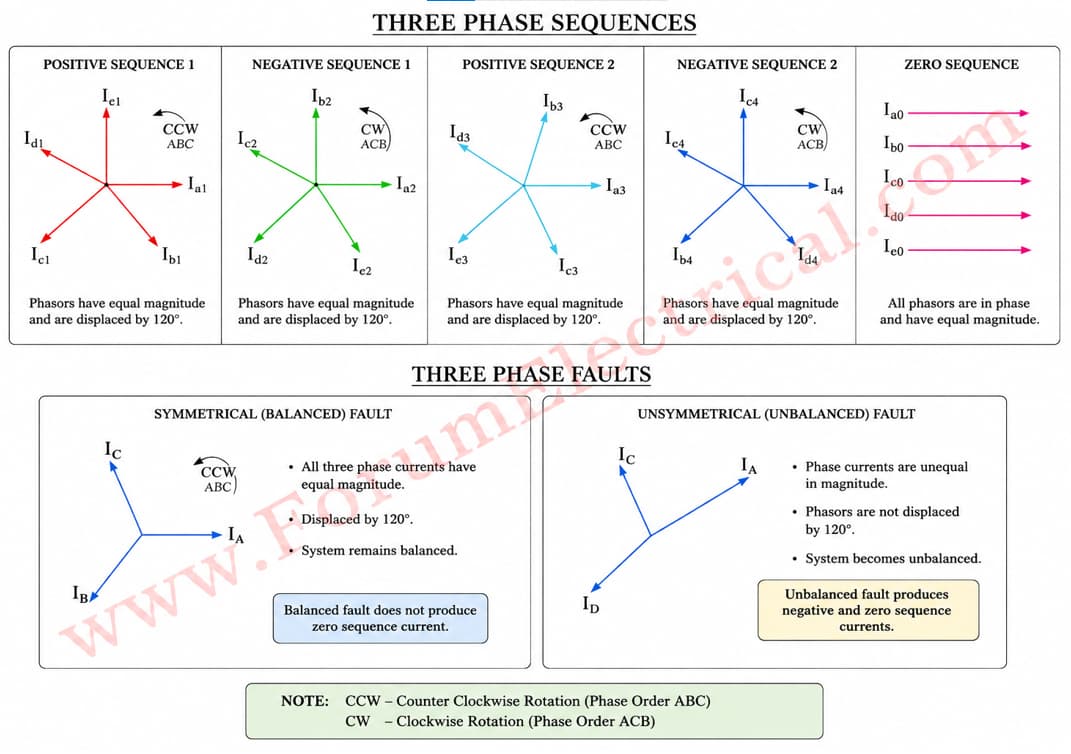
3). Zero Sequence
Three voltages or currents are equal in magnitude and in phase (0° phase shift).
Commonly associated with earth faults.
Exists when a return path is present (like through neutral or ground).
Eg: Single-line-to-ground fault in a system with grounded neutral will have strong zero-sequence current.