What is redundancy in PLCs and how is it implemented?
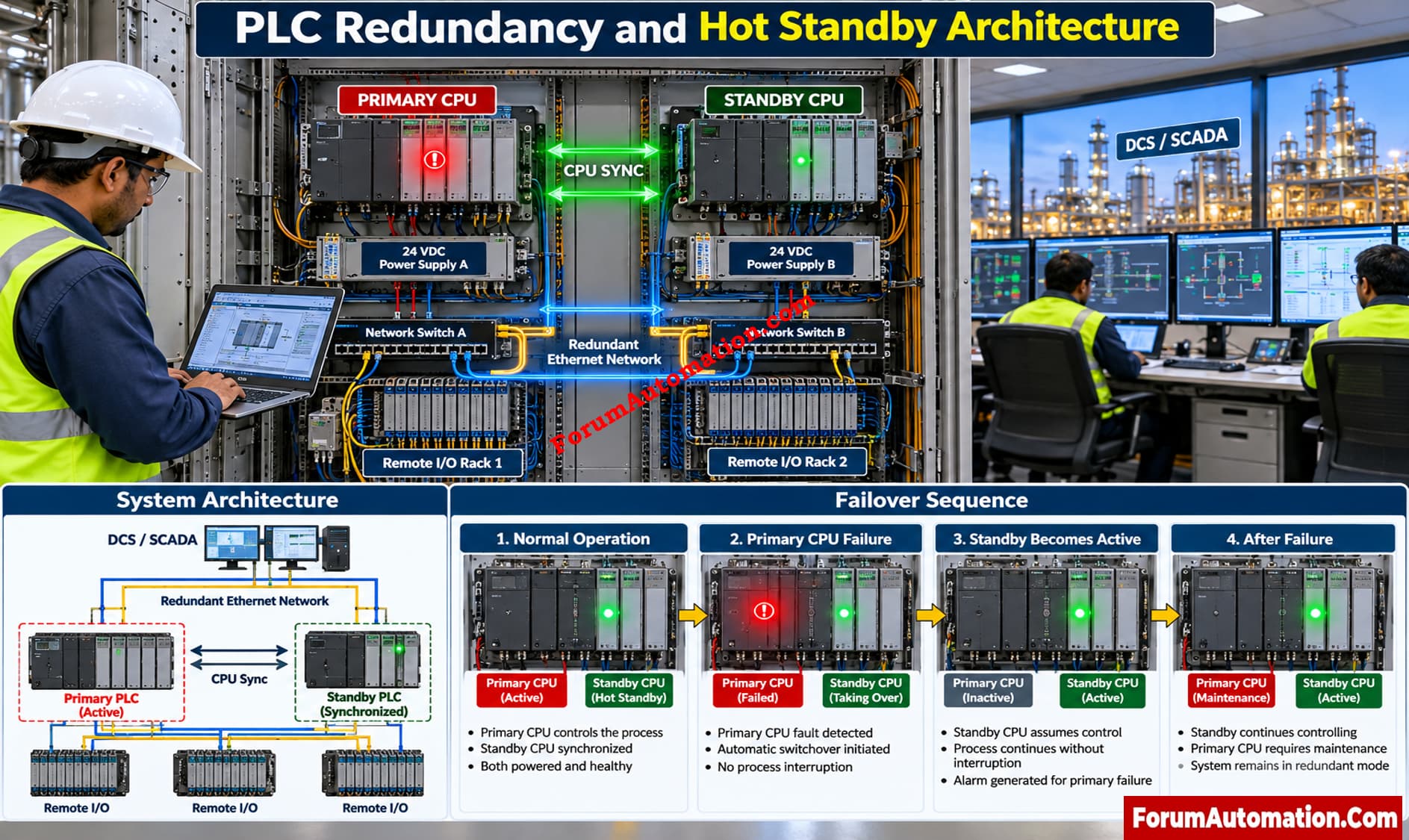
What is redundancy in PLCs and how is it implemented?
What is redundancy in PLCs?
PLC redundancy means multiple control components so the process can continue to operate in case a critical controller component fails. Redundancy can involve CPUs, power supplies, communication networks, remote I/O, or complete controller systems.
How PLC redundancy works
A common architecture uses a primary CPU and a standby CPU. Both controllers are powered and load sharing in hot standby. The standby receives process data, program status and needed variables from the primary. If the main CPU or rack or defined communication path fails, the standby will immediately take over.
Warm standby systems keep the backup ready but may require initialization during transfer. Cold standby normally means a spare controller is available but is not continuously controlling the process.
Practical implementation
A redundant PLC system should avoid hidden single points of failure. Consider:
- Dual independent power supplies and feeders
- Redundant communication paths or network architecture
- Suitable redundant or distributed I/O
- Synchronization links
- Automatic fault detection
- Defined output behavior
- Degraded redundancy alarms
- FAT and SAT failure testing
A continuous process may use synchronized CPUs, dual power supplies, redundant Ethernet paths, and distributed I/O. A packaging machine may only require a spare CPU because short downtime is acceptable.
Select redundancy from process criticality, allowable downtime, failure consequences, and maintenance strategy. High availability is not provided by simply installing two PLC CPUs if they share the same power supply, network switch, I/O interface or field cable path. This is important in commissioning.
ISA describes controller redundancy as a primary controller switching to a secondary after failures such as power loss, cable faults, rack faults, or processor errors. Hot, warm, and cold standby architectures differ mainly in synchronization and switchover behavior.