What is Modbus TCP/IP?
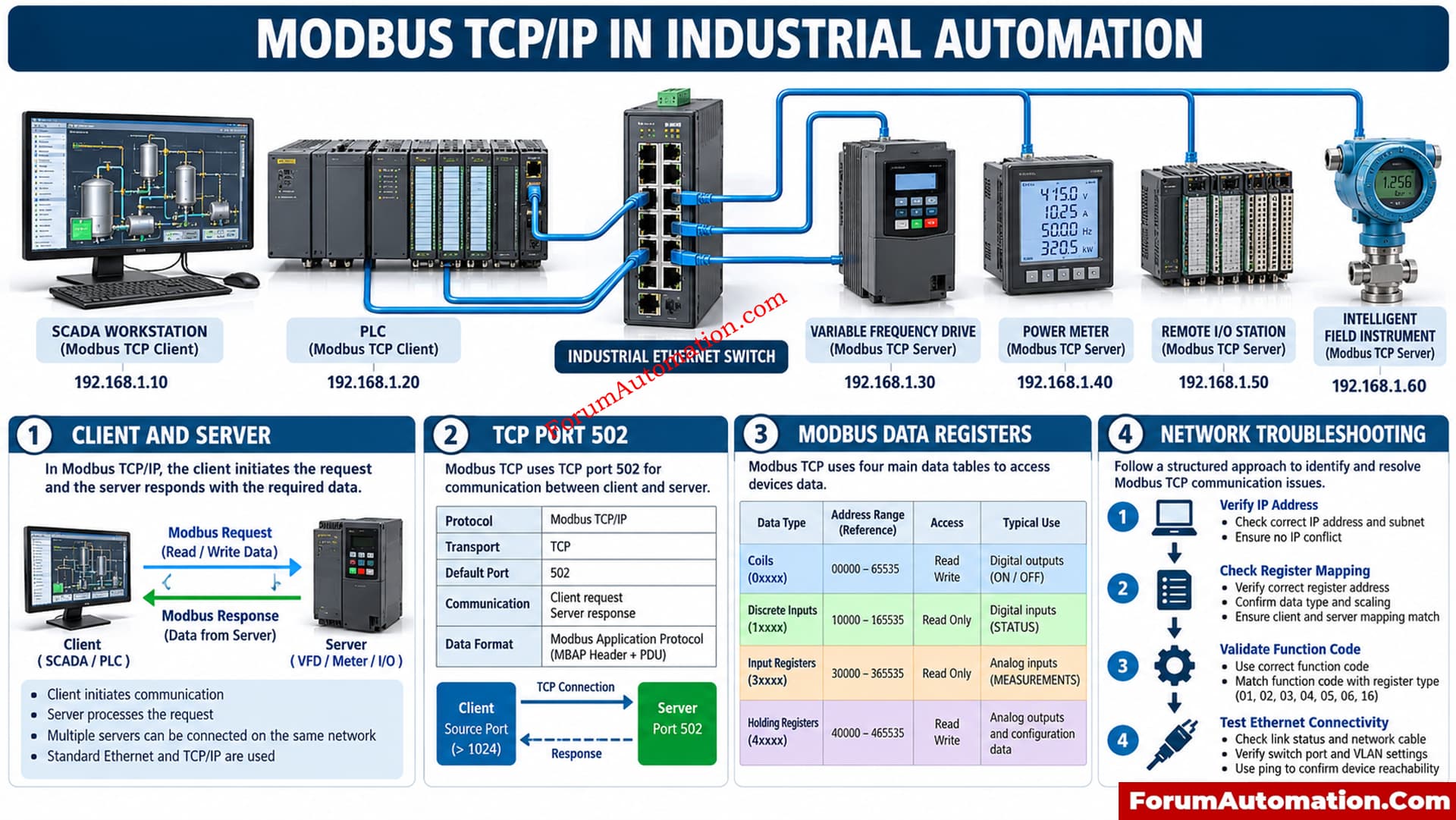
What is Modbus TCP/IP?
Modbus TCP/IP is an industrial communication protocol for data interchange between PLCs, SCADA systems, HMIs, remote I/O, meters, drives and other automation devices via Ethernet. The protocol combines the Modbus application layer with TCP/IP transport, enabling process information to be shared between compatible equipment made by various manufacturers. The Modbus Organization describes it as an open, widely used industrial protocol.
How does it work?
A Modbus TCP client delivers a request to a server. The server sends data or an acknowledgment of a write command. Communication commonly uses TCP port 502.
Common data areas:
- Coils: single bit values, often readable or writable.
- Discrete inputs: single bit status values.
- Input registers: 16 bit measured values.
- Register holding: 16-bit measurements, settings or commands based on setup.
Plant application
A PLC may read motor current from a power meter, monitor Drive Status and communicate with a Package Unit over Ethernet. Commissioning check register map, function codes, data type, word order, scaling and addressing convention.
Troubleshooting checks
If values are missing or incorrect, verify:
- IP address, subnet, route and TCP port 502.
- Client and server configurations, connection limitations and firewall rules.
- Address of the register, Function code, Data type, Polling interval
- Ethernet cabling, switch status and device diagnostics.
Modbus TCP/IP is straightforward but ordinary Modbus TCP does not natively enable encryption or authentication. Control access and network segment. Use allowed remote access techniques. Successful communication does not mean perfect mapping of register values or safe for control.