**What is hysteresis in control valves?**
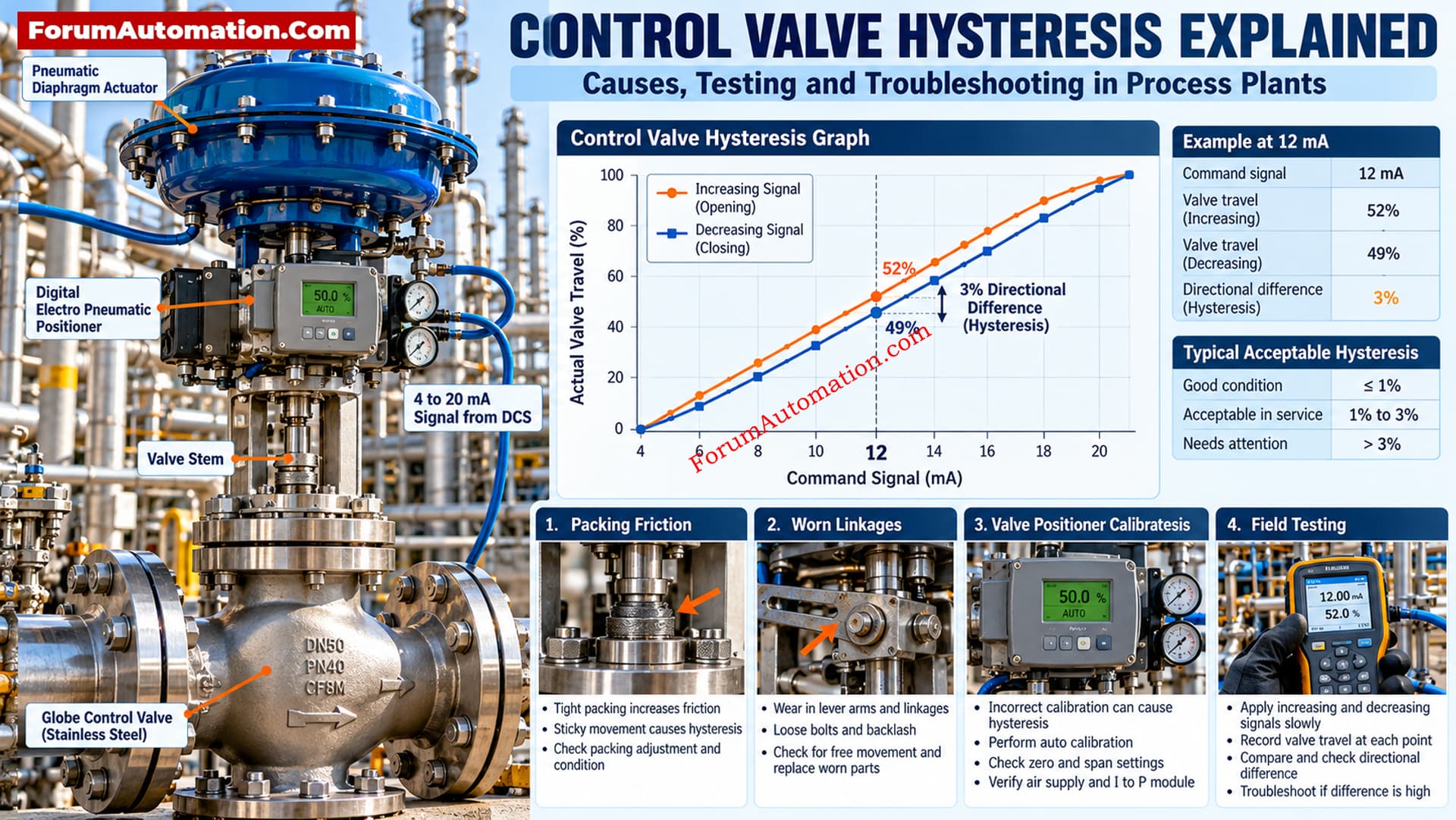
What Is Hysteresis in Control Valves? Causes, Effects and Troubleshooting?
Control valve hysteresis is the difference in valve position observed at the same input signal when the signal approaches from increasing and decreasing directions. It indicates that valve movement depends partly on its previous operating direction.
Practical Example
Consider a pneumatic control valve receiving a 4 to 20 mA command through an electro pneumatic positioner.
- During opening, a 12 mA signal produces 52% valve travel.
- During closing, the same 12 mA signal produces 49% travel.
- The observed directional difference is 3% of full travel.
This behavior indicates hysteresis, although deadband and measurement errors must be distinguished during formal testing.
Common Causes of Valve Hysteresis
- Excessive stem packing friction
- Worn actuator components
- Loose mechanical linkages
- Positioner feedback problems
- Damaged seals or inadequate lubrication
- Incorrect actuator alignment
Effects on Process Control
Excessive hysteresis reduces positioning accuracy and can produce unstable flow, pressure, temperature, or level control.
In operating plants, engineers may observe valve hunting, delayed response, repeated controller corrections, and increased mechanical wear.
How to Check Hysteresis
- Obtain operations approval and establish safe test conditions.
- Place the controller in manual mode when permitted.
- Apply increasing and decreasing command signals.
- Record actual valve travel at identical command values.
- Compare directional readings against manufacturer specifications.
Engineering Recommendation
Inspect packing, actuator movement, feedback linkage, and positioner calibration before adjusting controller tuning.]
Key takeaway: Correcting mechanical friction and positioning problems improves control valve repeatability, process stability, and maintenance reliability.