What is High Voltage Current Transformer (CT)?
A High Voltage Current Transformer (CT) is an instrument transformer used in power systems to measure large currents and to provide protection in high voltage networks safely.
It steps down very high current (like 200A, 1000A or more) to a small, standard value (usually 5A or 1A) for meters and protective relays.
Purpose
Measurement
Used with ammeters, energy meters, and power meters.
Protection
Works with protective relays to detect faults (overcurrent, short circuit, etc.).
Safety
Isolates measuring instruments from high voltage lines.
Where it is used?
Power transmission lines
Substations
Generator stations
Industrial high-voltage panels
For example, in a 33kV or 11kV substation, CTs are installed on outgoing feeders to monitor current.
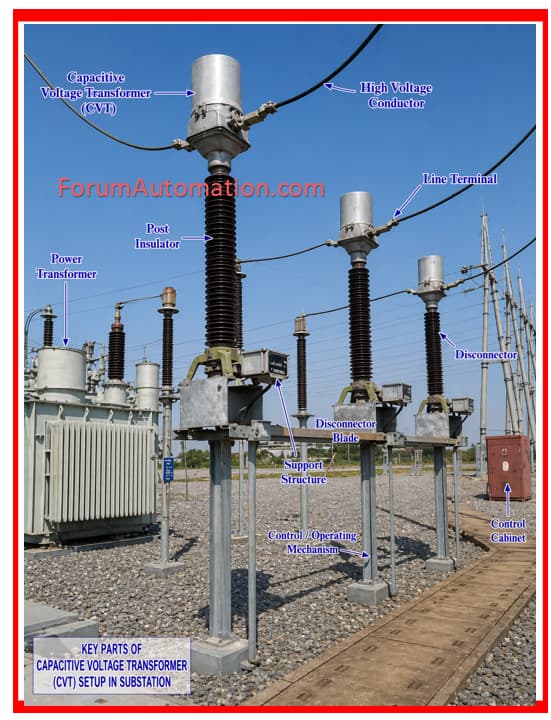
Working Principle
A CT works on the principle of electromagnetic induction (same idea as a normal transformer).
Primary winding: Connected in series with the high-voltage line (carries full load current).
Secondary winding: Connected to measuring devices (low current output like 5A or 1A).
If the primary current is 500A and the CT ratio is 500/5,
 When 500A flows in primary, 5A flows in secondary.
Types of High Voltage CTs
Oil-immersed CT
Used for very high voltages (e.g., 132kV and above).
Dry-type CT
Used in indoor switchgear.
Ring-type (Window CT)
Cable passes through the center.
Bushing CT
Built inside transformer or circuit breaker bushings.
Ratings
- Current ratio (e.g., 800/5A)
- Burden (VA rating)
- Accuracy class (e.g., 0.5, 1.0, 5P10)
- Insulation level (kV rating)