What is Ground Potential Rise (GPR) in Power Systems?
Ground Potential Rise (GPR) is the voltage rise of an earthing system with respect to remote earth during:
• Lightning Discharge
• Insulation Failure
• Backfeed Current
GPR = If × Rg
Where:
If = Ground fault current entering earth
Rg = Ground grid resistance
Even with low Rg, high fault current can elevate ground potential to several kV, energizing the entire grounding system temporarily.
Surface Potential Gradient
When fault current enters soil:
V(r) = (ρ × I) / (2πr)
Where:
ρ = Soil resistivity (Ω·m)
I = Fault current
r = Radial distance from electrode
This creates a voltage gradient across the earth surface.
Step Voltage
Voltage difference between two points on earth surface separated by 1 meter:
V_step = V(r) − V(r + 1)
Risk: Human body bridges this potential difference → current flows through legs.
Touch Voltage
Voltage between grounded metallic object and earth surface:
Vtouch = Vobject − Vsurface
Body current
Ib = Vtouch / (Rb + Rf)
Where
Rb = Body resistance
Rf = Foot-ground resistance
System-Level Impacts
• Equipment enclosure potential rise
• Transformer tank voltage elevation
• Insulation dielectric stress
• Partial discharge risk
• Protection maloperation
• Neutral shift
Neutral voltage displacement:
Vph = √3 × VLN
Healthy phases may experience overvoltage.
Electromagnetic Coupling
High di/dt during fault current causes:
Vind = M x (di/dt)
Induced voltage appears in:
• Control wiring
• Secondary circuits
• Parallel conductors
⸻
Soil Resistivity Influence
Ground resistance is directly proportional to soil resistivity:
Rg ∝ ρ
Higher ρ (rocky / sandy / dry soil):
Higher GPR
Steeper voltage gradient
Increased step & touch hazard
IEEE 80 Safety Limits
Allowable Touch Voltage:
Vtouch ≤ (1000 + 1.5ρ) / Cs
Allowable Step Voltage:
Vstep ≤ (1000 + 6ρ) / Cs
Where:
Cs = Surface derating factor
Hazard Duration
Fault energy exposure:
Energy ∝ I ²t
Longer fault clearing time increases risk of:
• Ventricular fibrillation
• Thermal shock
Engineering Mitigation
• Low resistance grounding grid
• Equipotential bonding
• Ground mat installation
• Surface resistive layer (e.g., gravel)
• Neutral grounding resistor
• Isolation of metallic structures
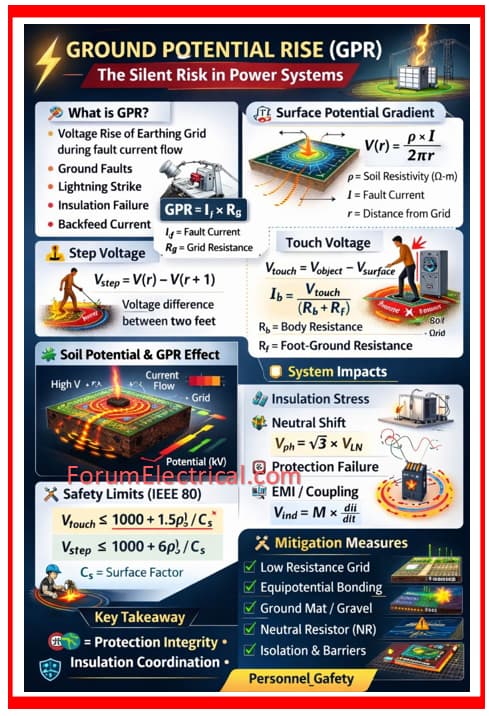
GPR is a transient elevation of local earth reference affecting:
- Protection integrity
- Insulation coordination
- Personnel safety