What is Grid Stability?
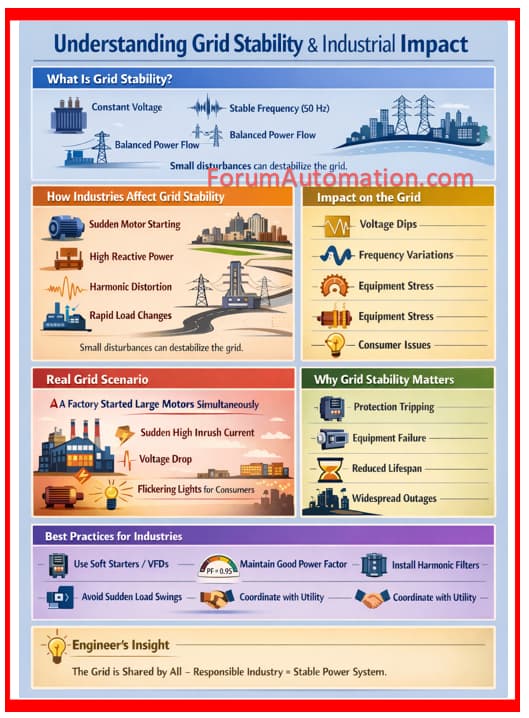
Grid stability refers to the ability of an electrical power system to operate continuously while maintaining key operating parameters within acceptable limits.
The system must be capable of withstanding disturbances without losing synchronism or collapsing.
A stable grid ensures that voltage levels remain constant throughout the network.
It also ensures that system frequency is maintained at its nominal value, which is 50 Hz in India.
Additionally, it ensures that power flow across transmission and distribution systems remains balanced.
Finally, it guarantees uninterrupted and continuous power supply to all connected consumers.
Even small disturbances such as sudden load changes or faults can propagate through the network and impact the overall system stability.
How Industries affect Grid Stability?
Industrial operations play a significant role in influencing grid behavior due to their high and dynamic power demand.
- Sudden starting of large motors can draw very high inrush current from the grid.
- High reactive power demand from industrial loads can cause voltage instability.
- Harmonic injection from non-linear loads such as VFDs and rectifiers can distort the waveform.
- Rapid load fluctuations in processes like rolling mills or arc furnaces can disturb system balance.
- Poor power factor operation increases current draw and stresses the electrical network.
These effects can collectively degrade the performance of the power system.
Impact on the Grid
- Voltage drops can occur due to sudden high current demand from industrial equipment.
- Frequency variations may arise when generation and load are not properly balanced.
- Electrical equipment in the utility network can experience additional thermal and mechanical stress.
- Sensitive consumers connected to the same feeder may experience power quality issues.
- In one real industrial condition a factory started multiple large motors simultaneously without proper control.
- This resulted in a sudden surge of inrush current being drawn from the supply system.
- The feeder voltage dropped significantly due to the high current demand.
- Consumers connected to nearby feeders experienced visible flickering of lights.
- This incident was not caused by a fault in the utility system.
- Instead, it was the result of improper load management at the industrial facility.
Why Grid Stability necessary?
Grid instability can lead to frequent tripping of protective relays and circuit breakers.
Electrical equipment may malfunction due to voltage and frequency deviations.
The operational lifespan of electrical equipment can be significantly reduced.
In severe cases, instability can lead to cascading failures and widespread power outages.
Maintaining grid stability is therefore critical for both utilities and end users.
Best Practices for Industries
- Large motors should be started using soft starters or Variable Frequency Drives (VFDs) to limit inrush current.
- Power factor should be maintained at 0.95 or above to reduce reactive power burden on the grid.
- Harmonic filters should be installed to mitigate waveform distortion caused by non-linear loads.
- Sudden switching of large loads should be avoided to prevent system disturbances.
- Industries should coordinate with utilities when planning to connect large or fluctuating loads.
- Adopting these practices helps in maintaining a healthy and stable grid.