1 Like
What is Critical Clearing Time (CCT)?
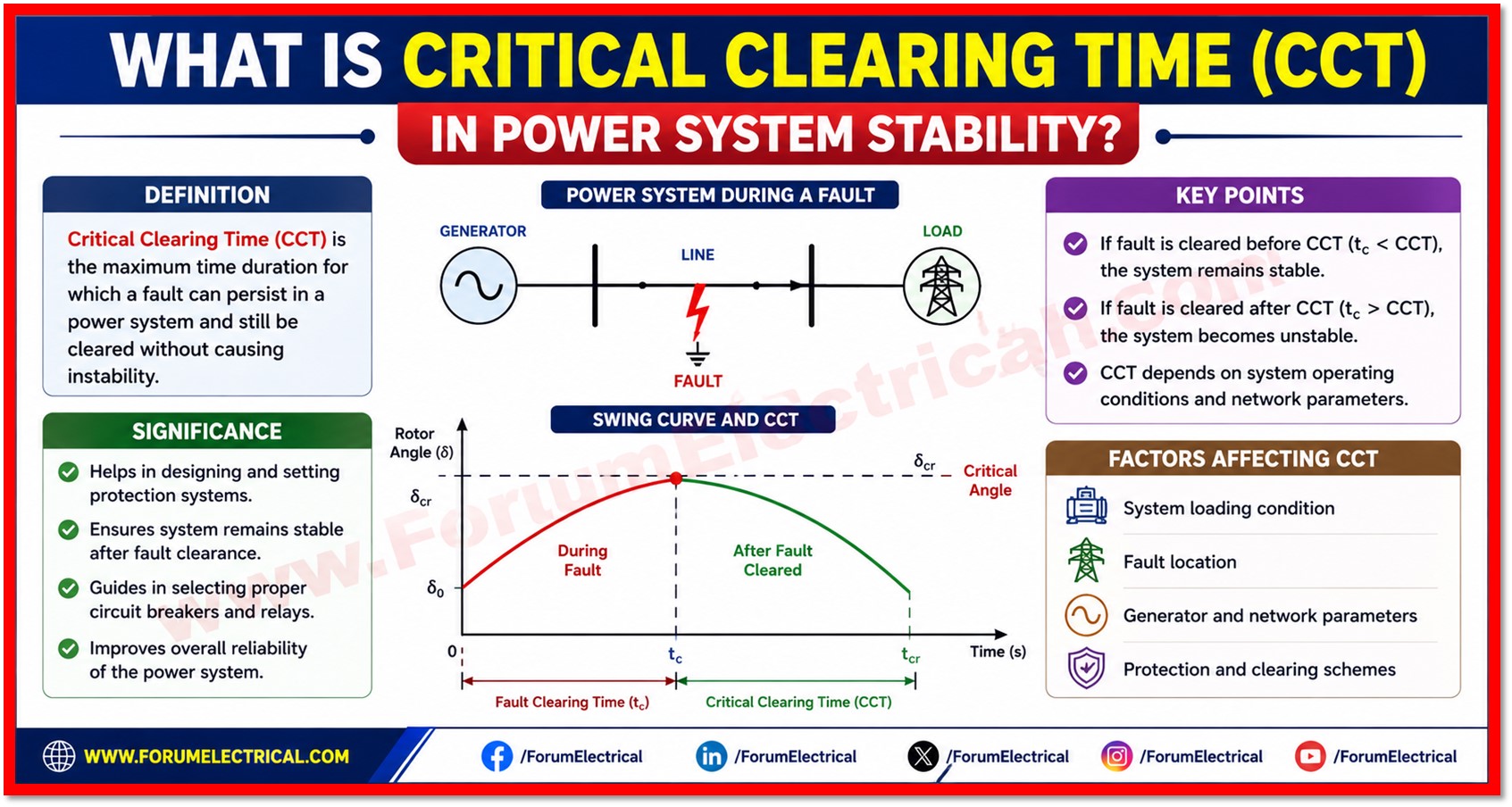
Critical Clearing Time (CCT) is the maximum time allowed to detect and clear a fault in a power system before the system loses synchronism.
If the fault is cleared within this time, generators remain stable and continue operating together.
If the fault persists beyond the CCT, the system may experience instability, generator tripping (or) widespread blackouts.
Why is CCT Important?
Critical Clearing Time is one of the most important parameters in transient stability analysis.
It helps protection engineers determine the required operating speed of relays and circuit breakers to ensure faults are isolated quickly enough to maintain system stability.
Factors affecting Critical Clearing Time
1). Fault type and severity.
2). Fault location in the power network.
3). Generator inertia and system strength.
4). Transmission line impedance.
5). Excitation and governor response.
6). Circuit breaker operating time.
7). Protection relay operating time.
Applications of CCT
1). Designing protection relay settings.
2). Selecting high-speed circuit breakers.
3). Transient stability studies.
4). Power system planning and expansion.
5). Grid reliability and security assessment.