What is Asymmetrical Fault Current?
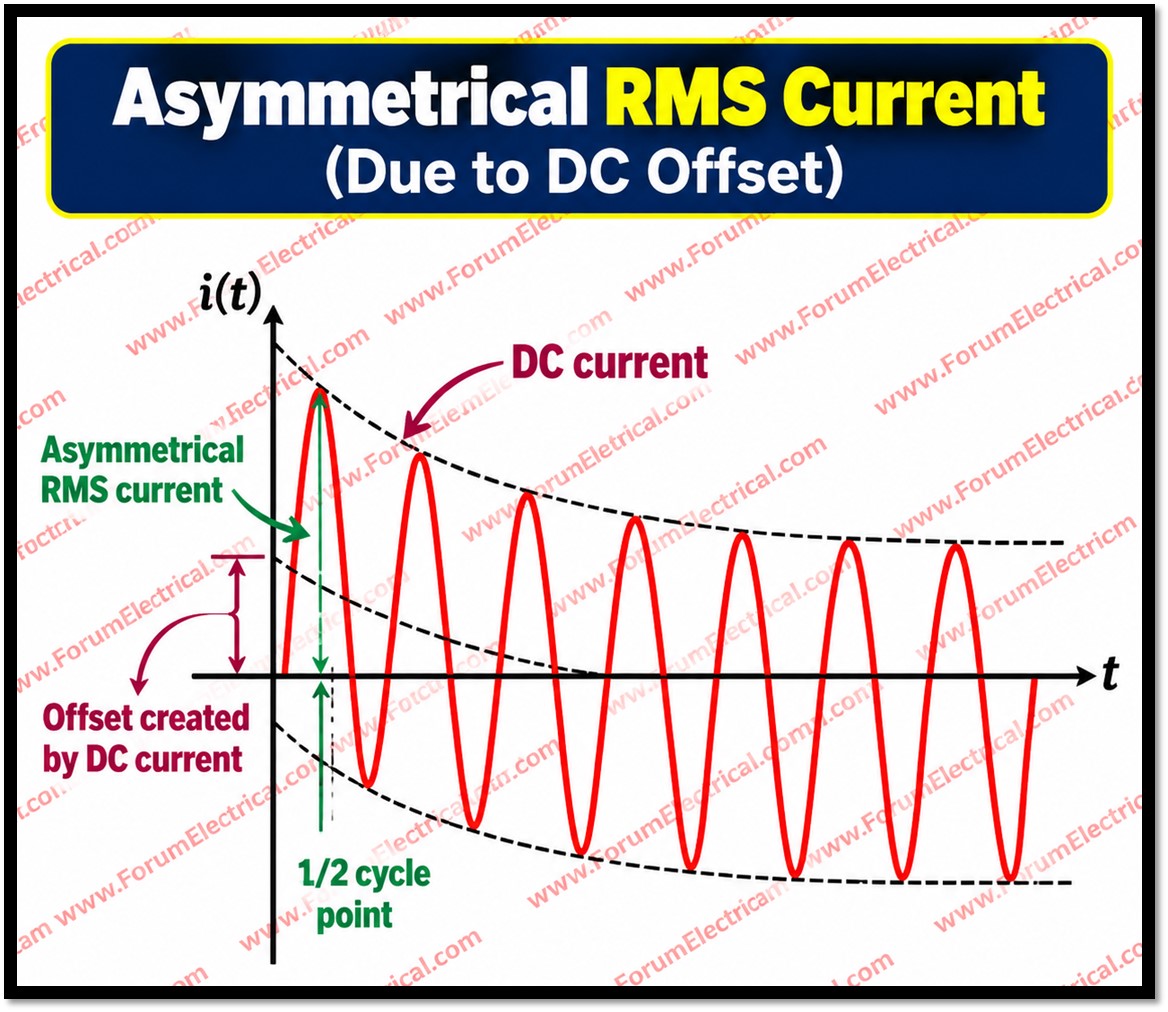
An asymmetrical fault current consists of both an alternating current (AC) component and a transient direct current (DC) offset component, producing a waveform that is initially displaced from the zero axis.
This DC offset results in significantly higher peak currents during the first few cycles following fault inception.
The DC component originates from the inductive characteristics of the power system.
Since inductance opposes an instantaneous change in current, a transient DC component is superimposed on the AC fault current.
This DC offset decays exponentially with time until only the symmetrical AC component remains.
A higher X/R ratio produces a larger initial DC offset and a slower decay resulting in higher peak fault currents.
Accurate modelling of asymmetrical fault currents is essential for short-circuit studies, protection coordination, equipment sizing, and maintaining system stability during fault conditions.
In practical power systems, the effective asymmetrical fault current is generally greater than the corresponding symmetrical RMS fault current due to the presence of the decaying DC component.
This effect is particularly significant for faults that are cleared within approximately 30 cycles making the consideration of asymmetrical current indispensable for the proper selection and rating of switchgear and protection equipment.
Understanding the asymmetrical fault currents enables engineers to design safer, more reliable and more resilient electrical power systems.