What is a Single-Line-to-Ground (SLG) Fault?
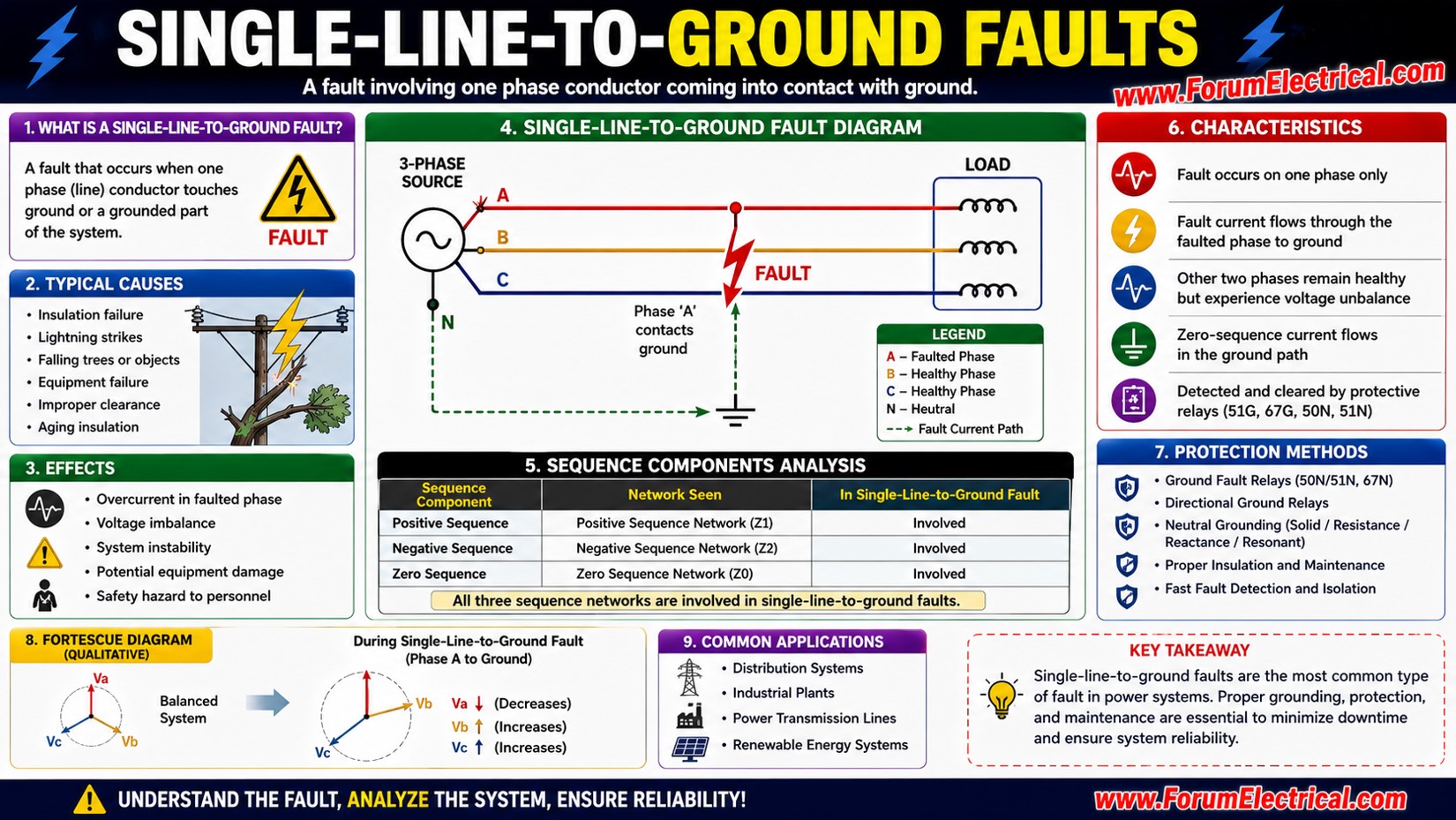
A Single-Line-to-Ground (SLG) fault occurs when one phase conductor accidentally comes into contact with the ground or an earthed object.
It is the most common type of fault in electrical power systems, accounting for nearly 70–80% of all transmission and distribution faults.
SLG faults can result from insulation failure, lightning strikes, equipment damage, tree contact (or) contamination.
Key Characteristics
Involves one phase and ground only.
Produces unbalanced currents and voltages in the power system.
Fault current depends on the system grounding method and fault impedance.
Requires fast detection and isolation to prevent equipment damage and maintain system stability.
Protection Methods
Single-line-to-ground faults are typically detected using:
- Ground fault relays
- Earth fault relays
- Overcurrent protection
- Differential protection (where applicable)
- Directional earth fault protection in interconnected networks
Why it is Important?
Understanding SLG faults is essential for selecting appropriate protection schemes, minimizing equipment damage, improving system reliability, and ensuring the safe operation of power transmission and distribution networks.