A Reverse Power Relay (ANSI 32) is a protective relay used to detect the reverse flow of active power (kW) from the electrical grid into a generator when the generator’s prime mover, such as a diesel engine, steam turbine, or gas turbine, fails or loses its driving power.
Under normal conditions, power flows from the generator to the load, but if the prime mover stops while the generator remains connected to the system, the generator begins operating as a motor and draws power from the grid.
The reverse power relay continuously monitors power direction using Current Transformer (CT) and Potential Transformer (PT/VT) inputs and trips the generator circuit breaker when the reverse power exceeds a preset value, typically 2–10% of the generator’s rated power, for a specified time delay of 0.5–5 seconds.
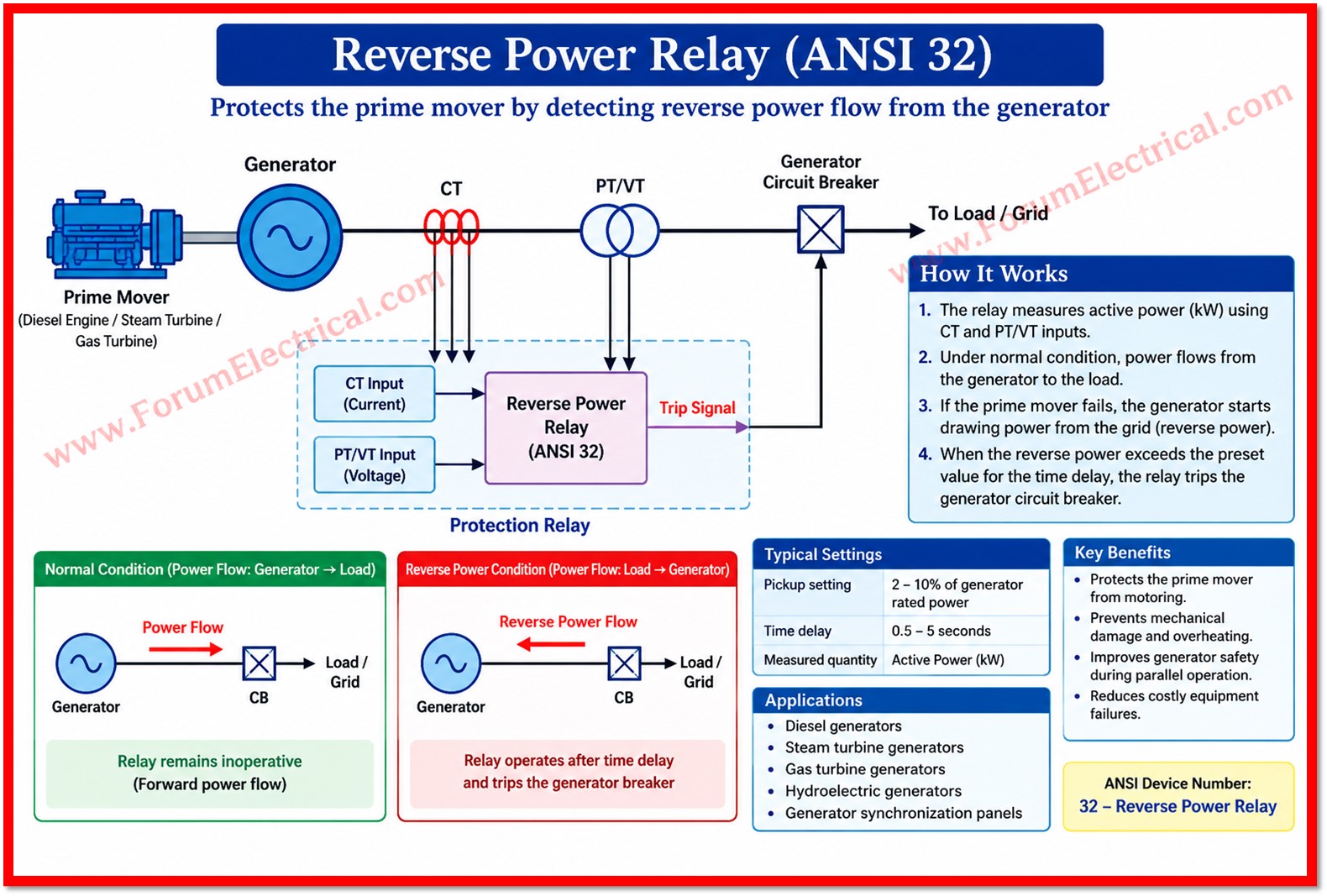
This protection prevents mechanical damage, overheating, and excessive stress on the prime mover, making it an essential protective function for generators operating in parallel with the utility or other generators.