What is 2oo3 voting philosophy?
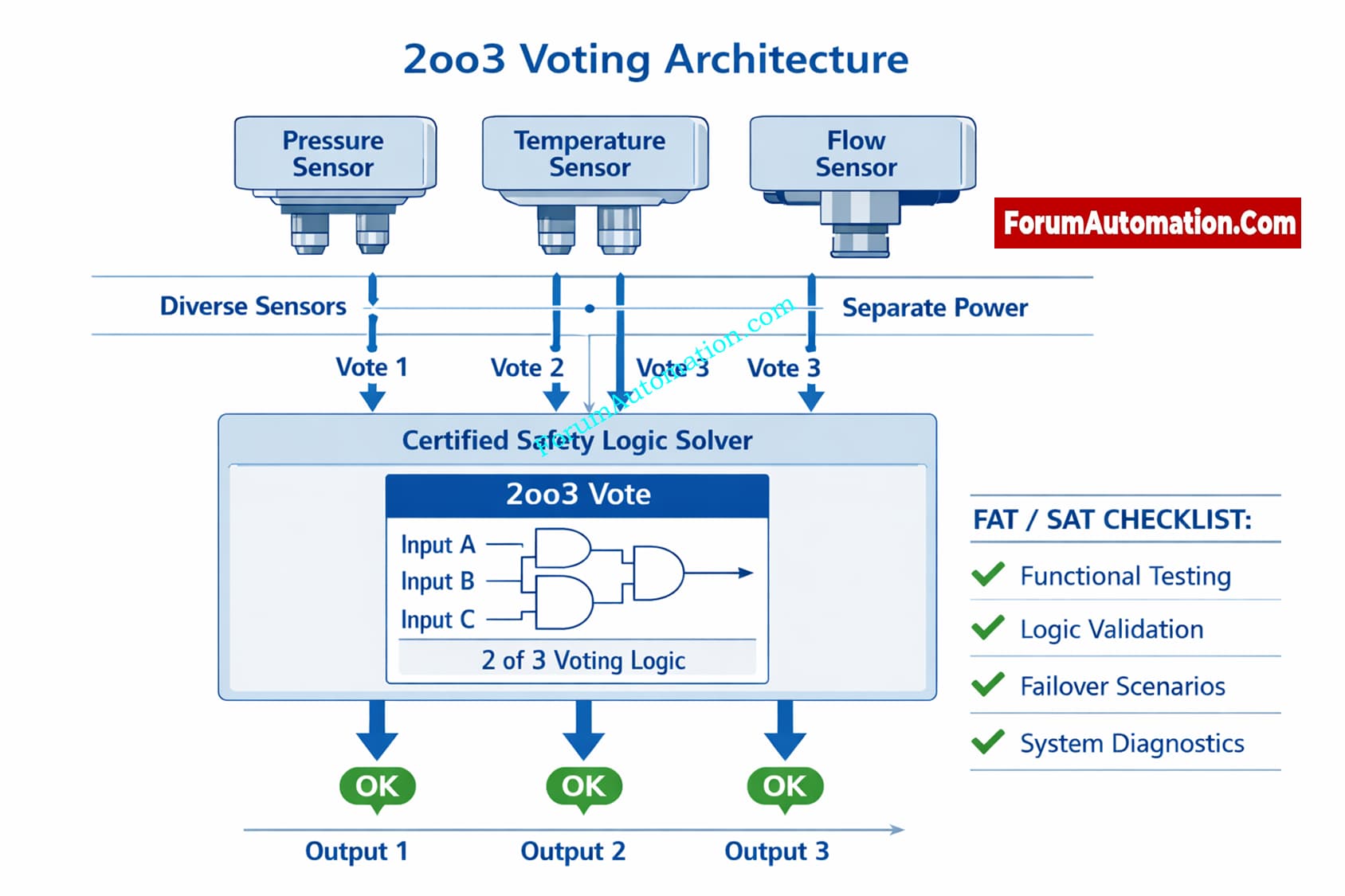
What Is 2oo3 Voting Philosophy?
2oo3 (two-out-of-three) is a MooN voting system that requires two of three channels to agree before a safety feature may be activated. It’s chosen to strike a compromise between safety and availability in systems that can’t handle frequent shutdowns but still need to be able to handle single-channel failures.
- Common for big spinning machines, continuous reactors, or important interlocks where one broken sensor shouldn’t make the plant trip.
- It prefers continuity over the perfect simplicity of 1oo1 and stays away from the extra spurious-trip sensitivity that certain duplex algorithms have.
Advantages
- Fault tolerance: the safety function can still work even if one channel fails.
- Less annoying trips: in many circumstances, needing two votes instead of 1oo1/1oo2 cuts down on false visits.
- Better diagnostics: comparing data across channels helps find drift and intermittent issues early…
Design & Implementation Checklist
- Before you choose 2oo3, do SIL/PFD calculations and spurious-trip analysis.
- Reduce the risk of common-cause failures by using distinct sensors, power sources, and physical separation.
- Use certified logic solvers or special voting modules to set up voting.
- Check using FAT/SAT, including fault injection, and keep track of the vote results.
Operational & Troubleshooting Tips
- If votes don’t always match up, check the wiring, loop power, time alignment of samples, and voting windows.
- Keep an eye on vote logs and trends, and employ proof-test intervals based on calculated failure rates.
- Write down the assumptions and lessons learnt during commissioning to improve the thresholds and maintenance plans.