What does 10 to 1 turndown mean?
What does 10 to 1 turndown mean?
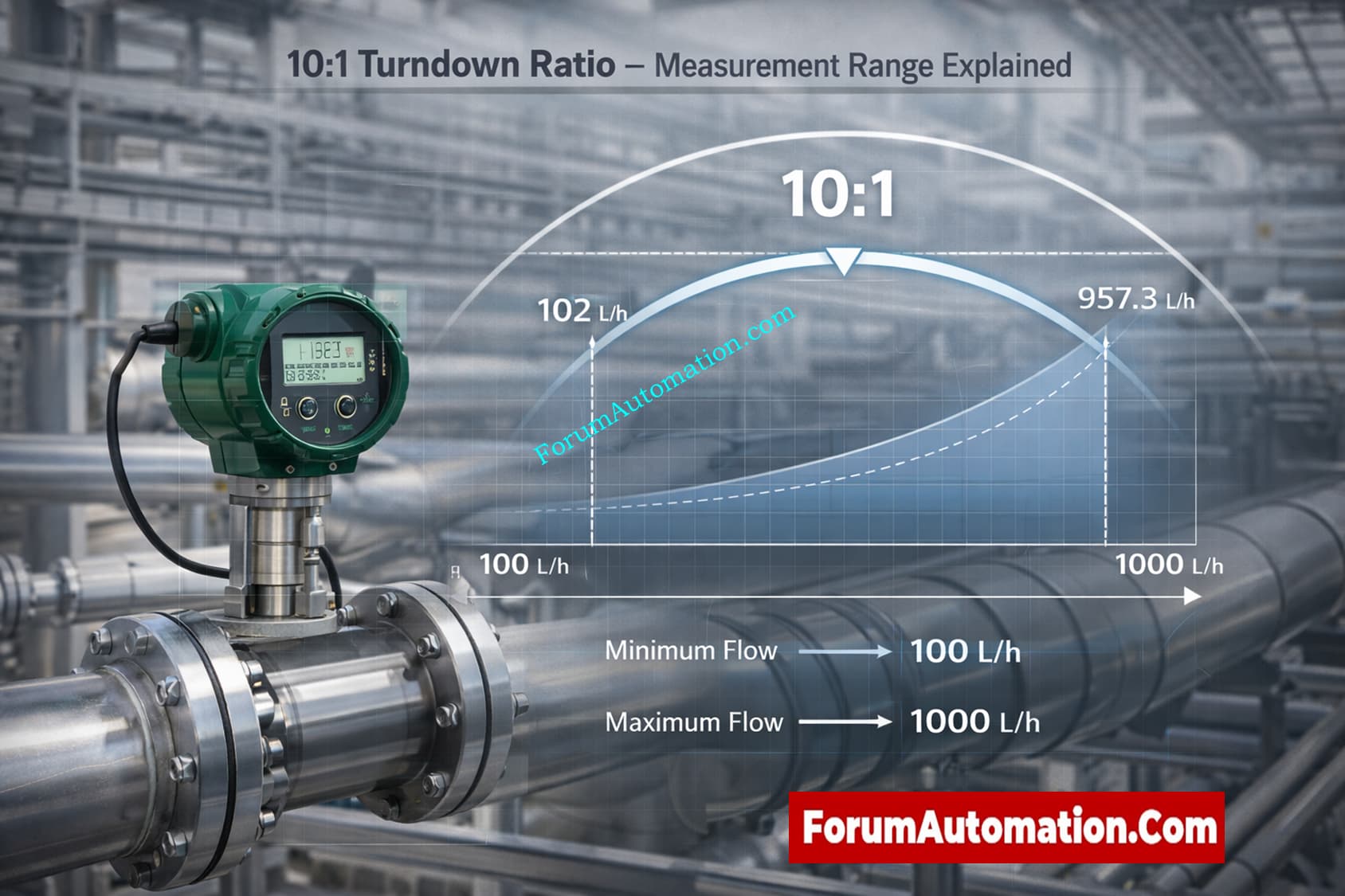
A 10:1 turndown (turndown ratio) means that an instrument or device can measure or control flow (or another variable) throughout a range where the highest value is ten times the lowest value that can be measured.
Explanation & formula
- Turndown ratio = Maximum measurable value / Minimum measurable value.
- Example: a flowmeter with full scale 1000 L/h and minimum accurate flow 100 L/h has turndown 1000/100 = 10:1.
Why it matters in plant work
- Accuracy at low flow: the instrument’s requirements are valid across the whole turndown range. Below the minimum, accuracy drops and noise takes over.
- Calibration and span: many transmitters have electronic turndown, which lets you change the span. You need to make sure that the calibration uncertainty at the lower span matches the process tolerance.
- Choosing: To avoid range mistake and having to change the meter or valve often, pick one with a turndown that is more than the projected process swing.
Field examples
- Batching: If the batch fills vary by a factor of 20, a flowmeter with only a 10:1 turndown may not work. You might want to look at 20:1 or dual meters.
- For steam tracing or low-flow custody transfer, utilize higher turndown or orifice plates with more than one range.
Practical checklist
- Check the manufacturer’s turndown specification and the accuracy that goes with it.
- Check the minimal measurable flow during commissioning (on-site test).
- If the needed turndown is more than the device turndown, employ upstream control schemes like bypass, parallel meters, or control valve staging.
Understanding turndown keeps control loops stable and prevents measurement blind spots. Write down any decisions to turn down instruments in their datasheets and P&ID notes so that they can be used for future maintenance and commissioning testing.