What Causes Motor Overheating?
Motor overheating is one of the most common causes of equipment failure in industrial plants. It occurs when the motor generates more heat than it can dissipate, leading to insulation damage, reduced efficiency, and premature failure.
Common Causes of Motor Overheating
Overloading: The motor draws excessive current when operating beyond its rated load, causing the windings to heat up.
Low Supply Voltage: Low voltage forces the motor to draw higher current to produce the required torque, increasing heat generation.
Voltage Imbalance: Even a small voltage imbalance between phases can create significant current imbalance and excessive winding temperatures.
Single Phasing: Loss of one phase in a three-phase motor causes the remaining phases to carry excessive current, leading to rapid overheating.
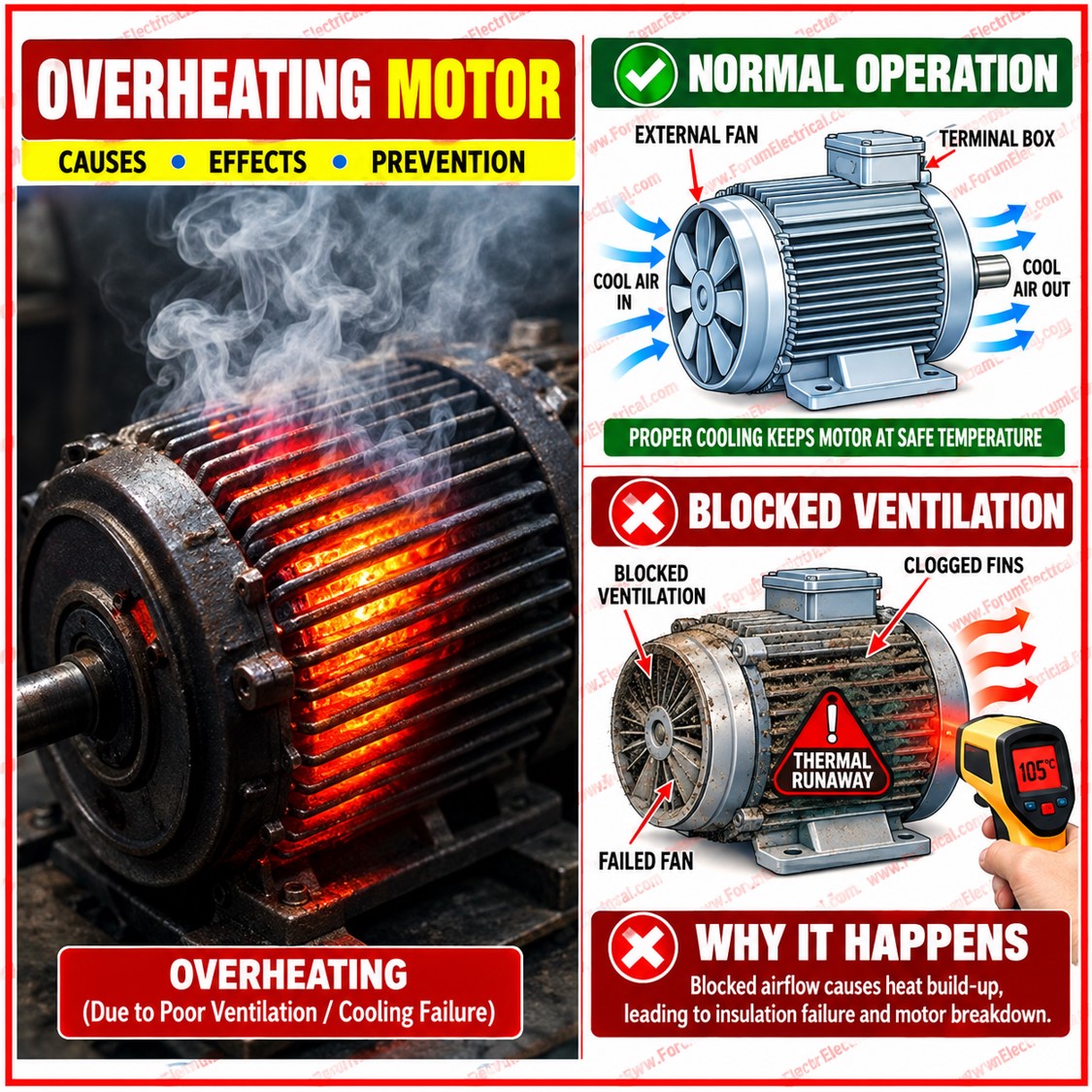
Poor Ventilation: Blocked cooling fins, damaged cooling fans, or restricted airflow reduce heat dissipation.
Bearing Problems: Worn, damaged, or poorly lubricated bearings increase friction and generate excess heat.
Mechanical Misalignment: Misaligned couplings or excessive belt tension increase mechanical load and temperature.
Frequent Starting: Each start draws high inrush current, and repeated starts without adequate cooling can overheat the motor.
High Ambient Temperature: Hot environments reduce the motor’s ability to dissipate heat effectively.
Improper VFD Settings: Incorrect VFD parameters, excessive low-speed operation without forced cooling, or poor cable installation can increase motor temperature.
Warning Signs
Motor casing feels unusually hot.
Burning insulation smell.
Protection relays trip frequently.
Increased current consumption.
Excessive vibration or noise.
Reduced motor performance.
Prevention Tips
Operate within the rated load.
Maintain balanced and correct supply voltage.
Clean cooling vents and fans regularly.
Lubricate bearings according to the manufacturer’s schedule.
Check shaft alignment and belt tension.
Use proper overload and thermal protection.
Monitor winding temperature with RTDs or thermistors.
Perform regular preventive maintenance and insulation resistance testing.
A motor’s winding insulation life decreases rapidly as temperature rises. As a rule of thumb, every 10°C increase above the insulation’s rated operating temperature can approximately halve its service life, making temperature monitoring and proper protection essential.